
Plymouth Valiant, Plymouth Duster, and Dodge Demon specifications
1960 Valiant specifications
The 1960 Valiant launched in September 1959 to numerous speeches and accolades. 1960 Valiant details.
- Base engine (170 slant six): 101 horsepower, gross
- 25 cubic feet of cargo space in the trunk
- Four door sedan and wagon (two and three seats) available in V-100 and V-200 trim
- Colors: silver gray, blue, green, white, black; V-200 also sold in red
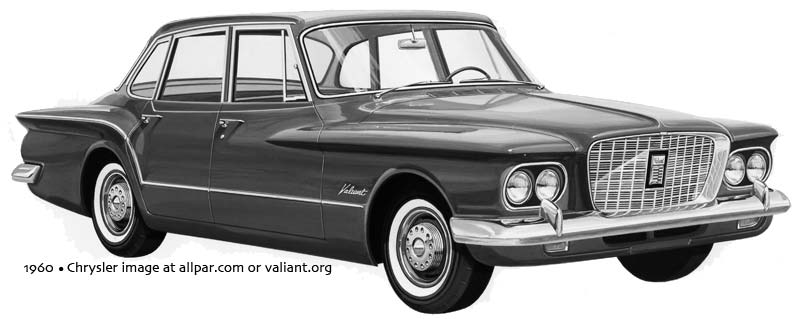
Standard equipment included a driver’s side sun visor, glove box, single speed electric wipers, and dual headlights. V-200 added deluxe interior trim, two-tone chrome-separated dash, arm rests in front and rear, dual sun visors, dual horns, cigarette lighter, rear ashtray, and locking glove box. Options included power brakes, power steering, radio, heater, variable speed wipers, tinted windows, driver’s side rear view mirror (yes, it was an option), padded instrument panel and sun visors, backup lights, and day/night mirror.
| 1960 Valiant Specs | 1960 Valiant Engine Details | |||
|---|---|---|---|---|
| Wheelbase | 106.5 inches | Engine | 170 slant six | |
| Length | 184 (3-seat: 185.1) | Compression | 8.6:1 | |
| Width | 70.4 | Carburetor | Single barrel downdraft, auto choke | |
| Height | 53.3 | Ignition | Single breaker, vacuum and centrifugal advance | |
| Sedan glass area | 3,338 square inches | Battery | 12 volt, 6 cell, 50 amp-hour | |
| Headroom (f/r) | 37.9 / 37.4 | Gasoline | 13 gallon tank, regular grade | |
| Legroom (f/r) | 44.4 / 38.9 | Coolant | 14 quarts with heater | |
| Hip room | 57.0 / 56.9 | |||
| Seat height | 11.4 / 14.0 | Front suspension | Torsion bars | |
| Tires | 6.50 x 13 inches | Rear suspension | Isolated asymmetrical leaf springs | |
| Front brakes | 9 x 2.5 | Body | Fully unitized | |
| Rear brakes | 9 x 2 | Trunk | 24.9 cubic feet (four door sedan) |
Chrysler noted: “About 18 months ago, a compact silicon 6-diode rectifier was perfected for guided missiles. This invention made it possible to construct a small, effective alternator for automobiles.” Hence, Valiant was one of the first cars anywhere to get an alternator rather than a generator.
Gears for the three-speed standard transmission were listed as “2.71 low, 1.83 second, 3.49 reverse” with a floor-mounted shifter, 9.25 inch clutch face, and suspended clutch pedal. The optional transmission was a newly lightened three-speed TorqueFlite automatic. The parking brake in this first year was foot operated and mechanical for safety (in later years a handbrake would be used, then the foot pedal again.)
1962 Plymouth Valiant
- Engines: 101-hp 170, 145-hp 225 slant six (215 lb-ft).
- 225 with 3-speed manual, according to Tom McCahill, did 0-60 in 13.0, and had >100 mph top speed and 40-60 of 7.0 seconds.
- First year for Signet
- Engine: 8.2:1 compression, regular gas
- Standard axle: 3.55:1
- Price: $1,951 without options for V-200 four-door
- Wheelbase 106.5”, length 184”, height 53.4”, width 70.4”, tread 55.9/55.6, 14 gallons gas
1967 Plymouth Valiant specifications
5 year, 50,000 mile warranty. Engine specifications were identical for U.S. Plymouth Valiant and Australian Valiant VC.
| Engine size | 170 slant six | 225 slant six | 273 V8 (2-barrel) | 273 V8 (4-barrel) |
|---|---|---|---|---|
| Manual Transmissions | 3 speeds | 3 or 4 speeds | 4 speeds | |
| Horsepower (gross) | 114 @ 4,400 | 145 @ 4,000 | 180 @ 4,200 | 235 @ 5,200 |
| Torque | 155 @ 2,400 | 215 @ 2,400 | 260 @ 1,600 | 260 @ 4,000 |
| Bore and Stroke | 3.4 x 3.125 | 3.4 x 4.125 | 3.63 x 3.31 | 3.63 x 3.31 |
| Compression Ratio :1 | 8.5 | 8.4 | 8.8 | 10.5 |
| Standard Tire/Wheel | 6.5 x 13 (wheel 4.5) | 7 x 13 (wheel 4.5) | ||
The engine was almost the same size as the optional V6 on the 2007 Sebring; and while the two cars had around the same wheelbase and length (within 2.2 inches), the Valiant weighed 700 pounds less.
| USA (1967) | Australia (VC) | |
|---|---|---|
| Largest tire/wheel | 7 x 13 (wheel 4.5) | 7 x 14 |
| Wheelbase | 108 | 106 |
| Length | 188.4 | 188 |
| Width | 71.1 | 69 |
| Height | 54 | 55 |
| Track (front/rear) | 57.4/55.6 | 55.9 / 55.6 |
| Headroom (f/r) | 38.4/37.3 | |
| Legroom (f/r) | 40.8/35.4 | |
| Shoulder room | 55.7 | |
| Seat height | 8.9 / 11.1 | |
| Knee room, rear seat | 4.2 |
Common specifications, USA and Australian Valiants:
| Suspension | Torsion bars and balljoints in front; 2.5" outboard-mounted asymmetrical leaf springs, rear; Oriflow shocks |
|
| Rear axle | Hotchkiss drive, hypoid rear axle; ratios 2.76, 2.93, 3.23, 3.55, 3.91 available | |
| Fluids | 18 gallons of fuel, four quarts of oil | |
| Electrical | 12 volt, 48 amp-hour battery base (38 amp-hour on 170), alternator standard | |
| Drum brakes | 9" diameter with 153.5 square inches of total lining (slant sixes) 10" diameter with 156.2 square inches of total lining (V8s) |
|
| Disc brakes | Front only; 102.3 square inches lining area. Rear is 10” diameter drum. |
1968 Valiant specifications
See an absolutely absurd number of 1968 Plymouth Valiant specifications including engine details.
Compared with the entire Plymouth car line and a much newer car:
| 1968 Specifications | Fury | Midsize | Barracuda | Valiant | 1995 Neon |
| Wheelbase | 119 | 116 | 108 | 108 | 104 |
|---|---|---|---|---|---|
| Track, front | 62 | 59.5 | 57.4 | 57.4 | |
| Track, rear | 60.7 | 58.5 | 55.6 | 55.6 | |
| Length, overall | 213.1 | 202.7 | 192.8 | 188.4 | 172 |
| Width, overall | 77.7 | 76.4 | 71.6 | 71 | 67.5 |
| Height, overall** | 56.3 | 54.7 | 52.6 | 53.7 | 54.7 |
| Head room, front | 39.5 | 38.6 | 37.4 | 38.4 | 39.6 |
| Head room, rear | 37.7 | 37.4 | 35.8 | 37.3 | 36.5 |
| Leg room, front | 41.8 | 41.9 | 41.7 | 41.7 | 42.5 |
| Leg room, rear | 37 | 36.3 | 30.2 | 34.5 | 36.5 |
| Shoulder room, front | 60 | 58.1 | 55.4 | 55.4 | 54 |
| Shoulder room, rear | 60 | 58.1 | 55.4 | 55.4 | 54 |
Engines:
| 170 Slant Six | 225 Slant Six | 273 V8 | 318 V8 | 340 V8 (Barracuda) |
383 V8 (Barracuda) |
|
|---|---|---|---|---|---|---|
| Gross Horsepower | 115 hp at 4400 rpm | 145 hp at 4000 rpm | 190 hp at 4400 rpm | 230 hp at 4400 rpm | 275 hp at 5000 rpm | 290 hp at 4400 rpm |
| Torque, lbs.-ft. | 155 at 2400 rpm | 215 at 2400 rpm | 260 at 2000 rpm | 340 at 2400 rpm | 340 at 3200 rpm | 390 at 2800 rpm |
| Carburetor type | 1-bbl. | 1-bbl. | 2-bbl. | 2-bbl. | 4-bbl. | 2-bbl. |
| Fuel | Regular | Regular | Regular | Regular | Premium | Regular |
1968 Australian Valiant VF Hardtop Coupe
| 225 “Big Slant Six | 318 V8 | |
|---|---|---|
| Gross Horsepower | 160 @ 4500 rpm | 230 @ 4400 rpm |
| Torque, lbs.-ft. | 220 @ 2,500 | 340 @ 2400 rpm |
| Compression ratio | 8.4:1 | 9.2 to 1 |
| Bore, inches | 3.4 | 3.91 |
| Stroke, inches | 4.125 | 3.31 |
| Displacement, cu. In. | 225 | 318 |
| Carburetor type | 2-bbl. | 2-bbl. |
| Fuel | Regular | Regular |
| Gearing (manual) | 2.95, 1.69, 1.00:1; Reverse, 3.67:1 |
not available |
| Rear axle | 3.23:1 | 2.92:1 |
| Wheels | 5” x 14” | 5” x 14” (Regal 770, 5.5”) |
| Brakes: total swept area | 254.5 sq in (drums) | 334.1 sq in (discs) |
| Weight (unladen, with fuel) | 2,960 lb and up | 3,070 lb and up |
Three-speed, fully synchronized manual transmission standard except with V8 and Regal, which had a standard TorqueFlite automatic. Power-assisted front disc brakes were standard on V8, optional on slant six. Power steering came with the automatic. Overall length was 200 inches, width 70 inches.
1968 Dodge Dart Hemi
This was a rare car, meant for drag strip use only. The list price was $5,146 with the factory racing package, which had no possible options — far from the Dart GTS V8 price of $3,189. The car weighed around 3,000 pounds; the 426 Hemi was good for 425 hp but was generally seen as under-rated.
The car used two four-barrel Holley carburetors with a cross-ram intake, gulping down high octane fuel. The manual transmission had a 2.66:1 first gear ratio and 1:1 fourth gear, running a 10.5 inch clutch. The Dana axle assembly had a SureGrip (limited slip) differential. The front suspension was torsion bars, as usual, with rear leaf springs. Front brakes were discs, rears were drums.
1970 Duster 340
From an excellent article in Car Life, March 1970:
0-60 in 6.2 seconds (automatic tested!)
0-100 in 17.5 seconds
30-70 mph in 5.3
Quarter mile in 14.72 @ 94.24 mph
14.8 mpg overall
List price, $2547; weight, 3105 lb (3520 as tested)
Gear ratios: 2.45, 1.45, 1.00 (7.91:1, 4.69:1, 3.23:1)
Plenty of room for four passengers and lots of luggage.
1971 Dodge Demon 340
Road Test magazine tested the 340 Demon (similar to the 340 Duster) in April 1971. They found the following:
0-60 in 7.8 seconds (with old-style tires and a 3-speed automatic!)
1/4 mile in 14.56 seconds @ 96 mph
Est top speed is 127 mpg
Fuel economy was 14.3/16.7.
Cornering, finish, luggage, performance, steering were rated excellent.
Details, instruments, quietness, ride, visibility, overall were rated very good.
Base price was $3400 including tach, stereo cassette, and automatic.
The 340 engine had a bore and stroke of 4.04 x 3.31, 10.5:1 compression, 275 gross hp @ 5,000 rpm; 340 lb-ft @ 3200 rpm.
Wheelbase 108, length 192.5, width 71.6, ground clearance 5.3, weight 3,353, 15.9 feet of usable trunk space.
1972 and 1975-76 Valiant and Dart
More detailed Dart and Swinger specifications (which are also good for Valiant) are in our 1972 and 1975 detailed writeups; Valiant, Duster, etc. were similar (identical for 1975). Our 1975 writeup also includes competitive comparisons to Maverick, Mustang II, Pinto, Monarch, Granada, Comet, and Nova.
|
1972 |
1975 |
1972 |
1972 |
1975-76 |
1971-1976 Valiant Coupe |
1971-1976 Scamp / Swinger |
1975-76 Valiant Sedan |
1975-76 Duster |
|---|---|---|---|---|---|---|---|---|---|
| Doors | 2 | 2 | 2 |
4 |
4 | 2 | 2 or 4 | 4 | 2 |
| Wheelbase | 108" | 108 | 111" |
111" |
111 | 108 | 111 | 111 | 108 |
| Length | 192.5" | 200.3 | 196.2" |
196.2" |
203.2 | 195.8 - 197 | 199.6 - 203 | 199.6 | 197 |
| Width | 71.7" | 71.8 | 69.6" |
69.6" |
69.6 | 71 | 71 | 71.7 | |
| Height | 53.0" | 52.6" |
54.0" |
53.9 | 52.9 | 54 | 54 | 53.4 | |
| Track-Front | 57.5" | 59.1 | 57.4" |
57.4" |
59.1 | 59.1 | 59.1-59.2 | 59.2 | 59.2 |
| -Rear | 55.6" | 55.6 | 55.6" |
55.6" |
55.6 | 55.6 | 55.6 | 55.6 | 55.6 |
| Headroom-Front | 37.5" | 37.2 | 37.6" |
38.7" |
38.3 | 37.2 | 37.3 | 38.3 | 37.2 |
| -Rear | 36.5" | 36.4 | 36.7" |
37.3" |
37.2 | 36.5 | 36.6 | 37.2 - 37.3 | 36.4 |
| Legroom-Front | 41.5" | 41.6 | 41.5" |
41.5" |
41.6 | 41.6 | 41.9 | 41.9 | 41.9 |
| -Rear | 29.9" | 29.8 | 31.9" |
35.9"' |
35.6 | 29.6 | 34.6 | 29.4 | |
| Shoulder Room - Front | 55.4" | 57.0 | 55.4" |
55.4" |
55.4 | ||||
| -Rear | 55.1 " | 56.6 | 55.2" |
55.5" |
55.4 | ||||
| Trunk capacity - cubic ft | 19.8 | 15.9 | 17.7 | 16.6 | 20.1 | ||||
| Gas mileage, six/manual | 17/23 | ~19 | ~19 | ~19 | |||||
| Gas mileage, V8/manual | 13/20 | ~16 | ~16 | ~16 |
The 1975 Dart four-door sedan weighed 3,140 lb with the slant six, 3,285 lb with the V8. Dart SE was 3,360 (six) or 3,450 (V8) pounds.
Hardtops were 3,115 - 3,265 lb for Swinger, 3,340-3,425 for SE (six and V8).
Coupes (Dart Sport) were 3,060 lb for slant six, 3,205 lb for 318, and 3,415 lb for 360 V8.
AXLE RATIOS, 1972 |
Six cylinder |
318 |
340 |
Manual |
3.23:1 |
3.23:1* |
3.23:1* |
Automatic (Standard) |
2.76:1 |
2.76:1** |
3.23:1 |
Automatic (Optional) |
3.23 or 3.55 |
3.23 or 3.55 |
|
* 3.55:1 with Sure-Grip and three-speed manual, or with Sure-Grip and four-speed manual and 340.
** 3.23:1 with SureGrip
1973
For 1973, all Valiant engines ran regular gas. The standard six was the 198; the 225 was optional (but popular). The standard V8 was the 318 two-barrel. The 340 was only available on the Duster 340.
| Engines | 198 | 225 | 318 | 340 |
|---|---|---|---|---|
| Bore x stroke | 3.40 x 3.64 | 3.41 x 4.13 | 3.91 x 3.31 | 4.04 x 3.31 |
| Carb | 1-barrel | 1-barrel | 2-barrel | 4-barrel |
| Compression ratio | 8.4:1 | 8.4:1 | 8.6:1 | 8.5:1 |
| Horsepower @ rpm | 95 @ 4,400 | 105 @ 4,000 | 150 @ 4,000 | 240 @ 4,800 |
| Torque @ rpm | 150 @ 1600 | 185 @ 1600 | 265 @ 2000 | 295 @ 3600 |
| Antifreeze | 13 quarts | 13 quarts | 16 quarts | 15.5 quarts |
Wheels: 14 x 4.5 standard, 14 x 5.5 on Dart 340. Many options. Battery 280 amp standard (base model), 34 amp alternator on slant six, 41 amp on V8; air conditioning, towing, and other options or packages would increase both battery and alternator (and sometimes tire/wheel size). Axle ratios varied depending on engine (slant six vs 318), and transmission. Only three-speed manuals were available except on Dart 340 which could get a four-speed manual, according to contemporary literature, which might have been wrong.
| Dodge Darts | Body | Standard |
Optional | Axle Ratio | Opt A.R. | Trunk (cu.ft.) |
|---|---|---|---|---|---|---|
| Dart | A | 198/318 | 225, 318 | Varies | 3.21 | 14.3 |
| Dart Sport | A | 198/318 | 225, 318 | Varies | 3.21 | 15.9 |
| Dart 340 Sport | A | 340 | 2.69 | 3.55 | 15.9 |
| 1973 Plymouth Valiant | |
|---|---|
| Headroom, front | 38.7 |
| ... rear | 37.3 |
| Legroom, front | 41.5 |
| ... rear | 34.7 |
| Trunk space | 14 cubic feet |
| Crankcase | four quarts of oil |
| Seat height | 8.6 front, 11.1 rear |
| Fuel tank | 16 gallons |
| Length | 195.8” (108” wheelbase) |
| Width | 71” |
- Track: 59.1, front; 55.6, rear. Height, 54”.
- Turning Circle, curb-to-curb: 38.3 ft.
- Seat height, front: 8.6”; rear: 11.1”
- Trunk Capacity: 14.0 cu. ft.
- Fuel tank refill capacity: 16 gals.
- Tire size: 6.95 x 14 (6 & V-8), E70 x 14 (340 V-8)
- Tire pressure, 6.95 x 14 wheels: 32 psi (E70 x 14 wheels: 28 psi)
- Compared with other cars:
Exterior Cricket Valiant Duster Scamp Barracuda Interior Cricket Valiant Duster Scamp Barracuda Wheel-
base98 108 108 111 108 Headroom–F 37.6 38.7 37.5 37.6 37.4 Frt track 51 59.1 59.1 59.1 60.2 Headroom–R 36.0 27.3 36.5 36.7 35.7 Rr track 51.3 55.6 55.6 55.6 60.7 Legroom – F 39.7 41.5 41.5 41.5 42 Length 167 195.8 195.8 199.6 193 Legroom – R 32.7 34.7 30 31.9 28.9 Width 62.5 71 71.8 71 75.6 Hiproom – F 52.5 57.2 57.2 57.2 57.1 Height 54.9 54.3 53.1 52.8 50.9* Hiproom – R 52.5 57.2 56.9 56.9 52.5 Trunk (cf) 12.2 14 15.9 14.3 7.4 Shoulder – F 52.5 55.4 55.4 55.4 57.5 * ’Cuda. Notes: Cricket is sedan version. F=Front, R=Rear Shoulder – R 52.5 55.5 55.1 55.2 55.3 1974
- For the first year, Valiant and Dart sedan had exactly the same body size. Styling did not change except details behind the rear door.
Engines 198 225 318 360 Bore x stroke 3.40 x 3.64 3.41 x 4.13 3.91 x 3.31 4.00 x 3.58 Carb 1-barrel 1-barrel 2-barrel 4-barrel Compression ratio 8.4:1 8.4:1 8.6:1 8.4:1 Spark plug type N14Y N14Y or 66P N13Y or 65P N12Y or 67P Power 105 150 220 Torque 185 265 280 All models had a 16 psi cooling system pressure and 195° thermostat with a 0.35” spark plug gap. Firing order on the six was 1-5-3-6-2-4; on the V8s, 1-8-4-3-6-5-7-2. The gas tank held 16 gallons of fuel, the engine held 5 quarts of oil including the filter, and the power steering system used 2.5 pints of fluid.
The 7.25 rear axle held 2 pints, the 8.75 held 4.5 pints; recommended axle oil was SAE90 unless the temperature was expected to be below 10° Farenheit. Then the factory suggested SAE80 down to -30°, and SAE75 in even colder temperatures (the factory put in oil “satisfactory to -20°F.”) Changing the rear axle fluid was not recommended unless it was contaminated.
Recommended oils in above-freezing temperatures were 10W30, 10W40, 10W50, 20W40, and 20W50. For temperatures dropping at times to -10°F, the factory recommended 5W40, 10W30, 10W50, and 10W50. For colder temperatures, owners were advised to stick to 5W20, 5W30, and 5W40. Most owners currently stick with 5W30 or 10W30.
The standard battery was 305 amps, with 375 amps optional. Slant six had a 35 amp alternator, V8 41 amps, air conditioned cars 50 amps, 65 amps optional (standard with electric rear defroster).
Trailer towing was rated at 100 pounds tongue load, 1,000 pounds trailer; with the A34 towing package, that went up to 200 lb tongue load and 2,000 pounds trailer. The trailer had to have its own brakes, and have at most 20 square feet of frontal area when the six was used.
Allowed tire and wheel sizes were D78, E70, and E78, depending on model and wheel; the D78 was available on 4.5 J and 5.5JJ wheels, the E70 and E78 on 5.5JJ wheels (radials were also available). All wheels were fourteen inches for 1974. Chains were not recommended for any of these sizes. Another option, for which chains were possible, were 6.95 tires on either wheel — but the same wheels were used.
6.95 translates roughly to P185/75R14 or P195/70R14. D size tires don’t have a modern equivalent but P185/75R14 fit on the 4.5” rims; the common substitute, P195/75R14 will fit but bulges out and probably is not ideal. Those with bigger wheels can move to P205/70R14.
You can tell if the “radial tire roadability package” was installed by the door sticker — if it lists “DR78” or “ER78” then it was probably installed. (The “R” stands for “Radial.”) Wheel sizes were 4.5J and 5.5JJ — the smaller tires could but put onto the larger wheels but not vice versa.
Appropriate modern tires to replace the D78-14 standard tire appear to be 195/75R14. If the width is acceptable, 205/70R14 also appear, but they may not fit on the standard 4.5-inch wheels.
1975
Full specifications are in our 1975 detailed Dart writeup (Valiant, Duster, etc. were identical in this year except in slight differences in length). Also see the 1972-1975 section above and the 1976 section below. 1975 and 1976 Valiants, Dusters, Darts, etc. were nearly identical in all respects (except Australian models). Wheelbase remained 108 inch on coupe, 111 on hardtop and sedan.
The 340 engine was replaced by the 360; Duster 340 was renamed Duster 360, and Dart 340 was renamed Dart 360. The 360 was only available in the cars with that number in their name. All other cars had the 225 slant six standard, 318 V8 optional.
Alternator: 35 amp for slant six, 41 amp for V8. All air conditioned cars had 50 amp alternators. All cars with electric rear defrosters had 65 amp alternators; customers could also special order those.
2013 Dodge Dart 1975 Dodge Dart Headroom, front 38.6 37.6 ... rear 37.0 36.7 Legroom, front 42.2 41.5 ... rear 35.3 31.9 Shoulder room, front 58.2 56.3 ... rear 56.1 56.0 Base weight (pounds) 3,173 3,140 Price, 2012 dollars $16,000+ Length 183.9 203.2 Width 72.0 69.6 Wheels were 4.5J on slant six and V8. Slant six tires were 6.95 x 14” while V8 tires started at D78 x 14” (also optional on the six). 5.5J wheels with E78 x 14 tires were standard on the Dart SE and 360 Sport, optional on Dart Swinger and Custom. ER78 x 14 tires on 5.5J wheels were optional across the board. Dart 360 got black sidewall bias-belted polyglass tires standard; steel-belted radials were optional across the board. For Dodge, four-speed manual Hurst shifters were optional on Dart Sport with the Rallye package. A fuel pacer system used the fender-mounted turn signal light. A radial tire package included a front sway bar (standard on SE and 360) and “special tuning.”
The weight varied. For four door sedans, the base and Custom slant six was 3,140 lb and the V8 3,285 lb. The SE added around 220 lb to the slant six and 165 to the V8. Hardtops were 3,115 lb (Swinger) or 3,340 (SE) plus 150 lb or 60 lb for the V8 (from Swinger or SE six). The two-door coupe started at 3,060 lb for Sport six, 3,205 for Sport V8, and 3,415 for Sport 360.
(For more comparisons to the 2013 Dodge Dart, see Allpar’s comparisons page.)
1976 Valiant and Dart
Also see the 1972-76 section.
Wheelbase: 108" (two door special) or 111" (others)
Front Tread: 59"
Rear tread: 55.6"
Length: 197" (Valiant two door) to 203.2" (Dart)Car & Driver, 1976 Dodge Dart Sport 1975 Valiant
Brougham*Corvette L82 Trans Am Mustang II Cobra Engine 360 automatic 318 automatic 350 automatic 455 manual 302 manual 0-60 7.3 7.1 7.0 8.9 0-100 26.4 19.9 22.3 40.0 Quarter mile 15.7 @ 88.3 19.7 sec 15.3 @91.9 15.6 @ 90.3 17.0 @ 78.0 Braking from 70 201 ft 220 195 ft 175 ft 214 ft C/D mileage 13.5 / 15.5 15 / 18 14.5 / 16.5 12.0 / 13.0 Not recorded Cost, as tested $4,825 $4,500 $10,053 $5,722 $5,884 Weight 3,650 3,655 3,820 3,305 - * From a prior year’s Car & Driver
Base model: 225 slant six or 318 V8; three speed manual transmission. All wheels had 14 inch diameters; regular wheels were 4.5 wide, 360 wheels were 5.5 wide. The battery was rated at 305 or 440 amps, alternators at 41 amps (base). The gas tank held 16 gallons. All had electronic ignition. Standard features included electric choke assist, hubcaps, fuel, temp, and ammeter gauges, color keyed armrests, concealed sapre, electronic voltage regulator, two-speed electric wipers and dual braking systems. Stereo was not available but a rear seat speaker (on the left side) was; oddly, rear decks were stamped with holes for stereo speakers in the rear.
1974-76 Valiant
Four Door Sedan2011-14
Chrysler 300CWheelbase 111 120 Length 203.2 199 Width 69.6 76 Height 53.9 58.4-59.2 Weight 3,140 (6) / 3,285 (8) 3,961-4,561 Ground clearance 5.3 ? 4.7-5.0 Cargo volume 14.0 or 14.3 cf 16.3 cf (500L) Front head room 38.3 38.6 - 36.9 Front leg room 41.6 41.8 Front shoulder room 55.4 59.5 Rear leg room 35.6 40.1 The Brougham was increasingly popular with people downscaling from higher-end cars to get better mileage. The package was mainly cosmetic, with color-keyed carpeting, velour seats (bucket or bench), “luxury door trim panels,” poorly-simulated woodgrain dashboard inserts, carpeted trunk, better sound insulation, day/night mirrors, molding sills, vinyl side moldings, drip rails, and deluxe wheel covers. Radios remained optional.
V8 buyers also got front bumper guards and manual disc brakes.
AXLE RATIOS, 1976
Six cylinder
318 V8
360 V8 With Sure Grip
3-speed manual (standard) 3.21 2.45 3.21 (or 2.71 with 318) 3-speed manual (optional) 2.94 2.94, 3.21 4 speed manual (standard) 3.21 2.94 (3.21 opt) 3.21 Automatic (Standard)
2.94
2.45 (2-door), 2.76 (4-door) 2.94 3.21 (or 2.71 with 318)
Automatic (Optional)
2.94, 3.21
2.94, 3.21
3.21 Government passing specs follow. A low speed pass started at 20 mph and was limited to 35 mph. A high speed pass started at 50 mph and was limited to 80 mph. The object being passed was a 55 foot truck; the car had to be 40 feet behind the truck when starting and 40 feet in front when finishing (for a low speed pass; a high speed pass made that distance 100 feet). The greater acceleration of the slant six Fury over the slant six Valiant is puzzling but may be related to axle ratios. Transmissions were not specified and we are assuming automatics. The Volare/Aspen actually had longer passing times. The Dodge Colt, with a 1.6 liter engine and manual transmission, beat the 318 but not the 360.
Slant Six 318 V8 360 V8 Slant Six Fury 440 Fury Low speed pass 475 feet / 11.0 sec 460 feet / 10.5 sec 405 feet / 8.6 sec 465 feet / 10.6 sec 400 feet / 8.4 sec High speed pass 2090 feet / 24.8 sec 1480 feet / 16.2 sec 1245 feet / 13.3 sec 1945 feet / 22.8 sec 1130 feet / 11.7 sec Government braking specs from 60 mph to a stop:
Valiant/Dart,
Drum brakesAny car,
Disc brakesFury/Monaco Taxi
(Disc brakes)Light load 225 feet 194 feet 220 feet Maximum load 225 feet 204 feet 215 feet (that’s what it says) Emergency brakes 450 feet 456 feet 495 feet Power brake
booster failuren/a 456 feet 475 feet For details on these engines: slant 6 | 273, 318, 360 | 340
Also see bulbs and fuses
 Your Privacy Choices