
The Chrysler Centura (Modified Chrysler 180/SIMCA)
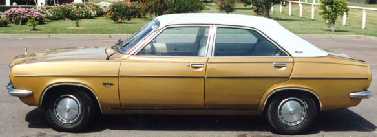 |
The Chrysler Centura, sold in Australia and possibly other areas, was a Simca (a French company owned by Chrysler) imported to Australia in the early 1970s. Chrysler Australia's highly skilled engineers fitted the Simca with the Valiant Hemi engine (a straight six), and an Australian four-speed Borg-Warner gearbox, tailshaft, and differential.
A four cylinder version with a French differential and two-piece tailshaft was also offered; while French citizens had a 1.8 liter engine, Australians, who did not tax based on engine size, were treated to 2.0 liter engines.
John Edwards wrote:
Centura engines were put in at the Chrysler plant in Tonsley Park. ... They were built to compete against the Holden Torana (GM). The factory also experimented with 318 powered prototypes (a few of my friends have done this V8 conversion), but the body lacked the rigidity to cope with the torque.
Locally, a Ford limited slip centre can be added to make up for the factory's inadequacies. Some Centuras can be found with hubcaps from Plymouth, a make which has not been marketed here since who knows when. I don't know if the factory supplied these. The people I have seen with them have no idea.
The Valiants and Chargers had torsion bar front ends, and leafsprung rears, but the Centura had coil springs all round.
 |
Heath Wogan wrote:
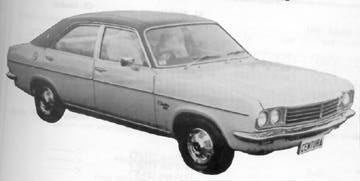
The Chrysler Centura was available in the KB and KC models. The KB car was available in a GL model while the KC car was available as a GL or GLX model. Velour seats and a collapsable steering column (as in the Valiants) were only available in the KC series; I believe rear demisters were also only available in the KC cars but I'm not sure.
I have owned three KB Centuras and found them all to be extremely reliable. My first was a 4 cyl, 4 speed which I later replaced with a 245 with three speed. My present Centura is a 265 with a Toyota 5 speed transmission.
The Centuras are extremely light in the rear and suffer in handling a little, but it is possible to achieve decent handling. The major attraction is the straight-line performance. With a relatively stock motor it is possible to achieve quarter mile times in the 15 second bracket. I have heard of a street-legal Centura which achieved 11.1 second quarter mile times at Oran Park near Sydney.
The 2.0 litre motor was an overhead cam, alloy-head crossflow with a two barrel Weber. The 2.0 litre version was available as a basic setup or as a sports model which included a sports exhaust system: 4-into-2-into-1. The K-frame supporting the 4 cylinder differed to the frame supporting the six at the forward control arm mounting. The six had the mounting integrated with the K-frame while the mount was merely suspended from the chasis in the four cylinder models. The four cylinder models also lacked the vented disc brakes of the sixes and I believe some had a 4-stud wheel pattern as opposed to the sixes 5-stud pattern.
My 4 cylinder used a 2-barrel Weber carburetor with a water controlled choke; they also had a thermatic fan. It started off on the production line as a six and was therefore equipped with all the six cylinder components (including the K-frame). With the six suspension my four cylinder model handled exceptionally well around corners. Parts are hard to get for the motors but I heard of a guy who had the 2.0 litre taken to a 2.8 litre with Chevy pistons, which improved performance to the extent that it was challenging many V8s.
The fours were only available with a 4-speed or automatic gearbox. Chrysler's styled rims were an option on the Centura.
Darren Ponton, of the City of Perth, wrote that, just before the Chrysler Centura arrived in Australia, the French conducted nuclear tests in the South Pacific. The Australian Waterside Workers Union banned on handling French products, and the newly elected Labour Government were sympathetic (or didn't want to upset them) so the bodies were left on the wharves until 1974 when the tests stopped (for a while). As result of all that "sea air" many Centuras started rusting before they were built!
Chrysler Centura pictures
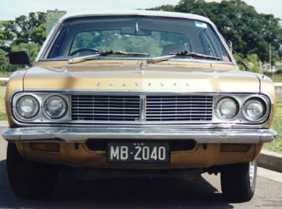 c9520084 wrote: I own a KC Centura with a 245 high compression engine and a stock auto. It's a GLX with all the trimmings. She's pretty original down to the cloth seats and the badge on the bonnet.
Links
- Chrysler Centura history and building Centura models
- Australian Valiant cars
- American Valiant cars
- New Zealand Valiant Chargers
- The Simca 180
- Other Simca and EuroChrysler cars
- Allpar (Chrysler enthusiast site)
 Your Privacy Choices