
The Revolutionary New 1960 Valiant from Chrysler
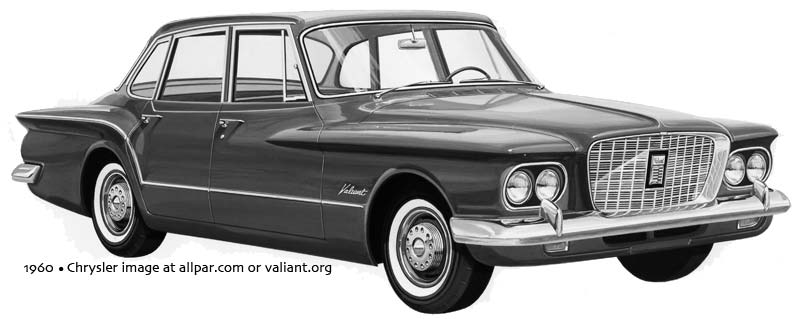
When they were launched in 1959, the 1960 Valiants were the best a mighty Chrysler Corporation could do. With alternators only recently wrung out of the space program, a hot new engine — Chrysler’s first new six-cylinder since the war — and radical Virgil Exner styling, the Valiant was even one of the first cars to be developed with the help of computers. They had a torsion-bar front suspension which at the time was hard to equal, and had been the subject of years of engineering and testing. With the Valiant, Chrysler was ready to re-conquer Europe and other lands, not to mention attack a new segment of the domestic car market.
In the early stages of engineering, computers were used to predict the dynamics, even before prototypes were built. This let engineers evaluate numerous designs without the costs of construction; though they still made plexiglass prototypes to increase durability. In the end, the Valiant used full unit construction, with integral body and frame welded into a single solid structure; while the body was strong and resistant to twisting, weight was minimized by this method. Indeed, Chrysler converted nearly every car it made to this construction method in model-year 1960.

The original Valiants were highly praised for their handling. As Curtis Redgap wrote, ‘The 1960 model was flung around and wrung out by Tom McCahill, one of the greatest auto testers and journalistic gentlemen who ever graced a printed page. He put the small car through the same paces as he did with all his test mounts. He was truly impressed, and prasied the handling as one of the best he had ever driven right out of the show room!
“Mr. McCahill was also the first tester to note the differences in a right turn and a left turn with the slant six weighted bias. The turn to the right was normal. However, the turn to the left was much tighter. He said it was not dangerous and the normal driver would never know. ... I remember being driven in the 1960 Valiant. It was one of the smoothest new cars I had ever experienced.”
 Information from an article by Richard C. Ackerson printed in Classic Car Exchange and reprinted by the Plymouth Bulletin. See also our "development story of the Plymouth Valiant."
Back in the 1950s, the Big Three started to notice an increasing number of foreign cars being imported to the United States. Even though Detroit was still in command, Chrysler - as well as Ford and GM - started work on smaller cars to compete with the new entrants from Germany, England, and France. In May, 1957, Chrysler finally decided to create a new small car in "Project A-901." From the very beginning, the Valiant's creation seemed to echo that of the later Neon, with the idea of making a smaller, lighter car that did not sacrifice too much passenger comfort or luggage space, and was not merely a scaled-down mid-size, along with superior handling, an attractive appearance, and a high-technology, efficient engine (with European models as a benchmark for both). Virgil Exner, who was still in charge of styling at the time, put interior space at a premium, but still sought to make sure the Valiant did "not look small or tiny from a distance." Styling was original, without massive fins, but including sports car cues.
The Valiant had the smallest wheelbase of any Plymouth produced since the 1930s' PC, at 106.5 inches, but it also had a long body for a compact at 184 inches. That led to a great deal of overhang (the opposite of the Neon!), which was good for styling - it could have a long hood and short rear deck appearance without losing interior or luggage space. The grille was a mix between the Chrysler 300 and 1959 Studebaker Lark (coincidental).
The interior was indeed spacious, with more leg room than the Ford Falcon or Chevrolet Corvair (albeit with less head room than the Corvair). The interior was also comfortable and nicely styled, not nearly as spartan as many other vehicles of the time. The manual transmission was a close-ratio three-speed, with a long throw, while the automatic had a pushbutton control (with a switch for Park). Gauges and controls were well designed and easy to learn and operate, a triumph in an era where ergonomics was not a household word.
Despite unit-body design - at that time still advanced technology - the Valiant had a very tight feel, with good rigidity and soundproofing. Driving an existing 1960 Valiant is still an amazing experience; acceleration is better on all new cars, but handling is still competent by modern standards, and the ride is surprisingly good, feeling like a larger, newer sedan. The Torsion-Aire suspension was quite advanced, with lengthwise unequal-length control arms and torsion bars up front and the de rigeur leaf springs in back.
Engines and powertrain
At the time, the Valiant's engine was very advanced, and also very new. The slant six was used for the first time in the Valiant, lasting through to the 1980s. The 225 cubic inch version produced more power than the Chevrolet and Ford compacts' engines, while the 170 was competitive and economical. The key to its success was indeed the slant, which allowed room for a modern and efficient intake manifold. 101 horsepower (gross) does not seem like much now, but that was with the stock Carter single-barrel carb, and torque was higher than most 2000 small cars - also, many suggested that it was actually more like 115 horsepower!

With an automatic, zero to sixty times were claimed at 16.7 seconds, though Road and Track reported a 13.9 second time. Chrysler tested two 1961 models, with similar mechanicals, in a four hour endurance run, where they had average speeds of over 95 miles per hour - and gas mileage at those speeds of around 12 mpg. In a later test at 40 mph, they achieved over 30 mpg. (Both cars were taken randomly from the production line.) A Ram-Air, HyperPak equipped, tuned Valiant managed to lap Daytona at over 122 mph, beating the Corvair and Falcon by a large margin. (The Hyper-Pak was offered briefly as a dealer-installed option producting 148 horsepower.)
1960 Valiant Models: V-100 and V-200
- Both available as four door sedan and wagon (two and three seats)
- Colors: silver gray, blue, green, white, black; V-200 also sold in red
V100 used a multi-colored, nylon-faced, acetate-based seat cloth in a free-form block pattern with gray vinyl bolsters; V-200 used a similar materail in a brocade-like pattern with fine metallic threading for highlights and borders of grained vinyl. Interior trim colors on V-200 were coordinated with exterior paint. V100 had rubber mats, V200 had color keyed carpet; trunk mats in both cases were gray rubber.
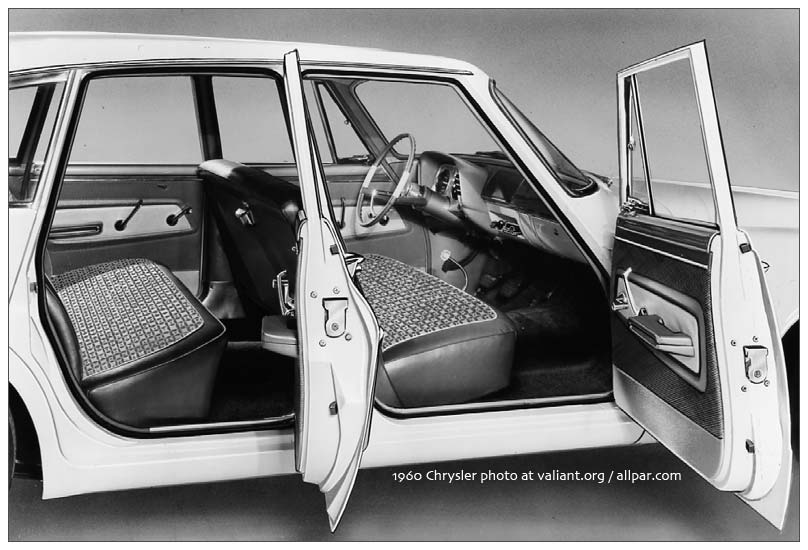
V100 had one color for seats and door panels, while rear shelf, door garnish molding, and dash metals were color keyed to the body; V200 had blue, green, and red interiors. V-200 used a two-tone steering wheel with bright horn ring, while V-100 was blue-green with a medallion horn button.
Problems with the original Valiants included water leaks and misaligned body panels, which may have consigned many of the first generation to the crusher due to rust. There are still quite a few out there, though.
See also our Valiant development history!
 Your Privacy Choices