
The Plymouth Duster / Twister, Dodge Demon, and Plymouth Scamp
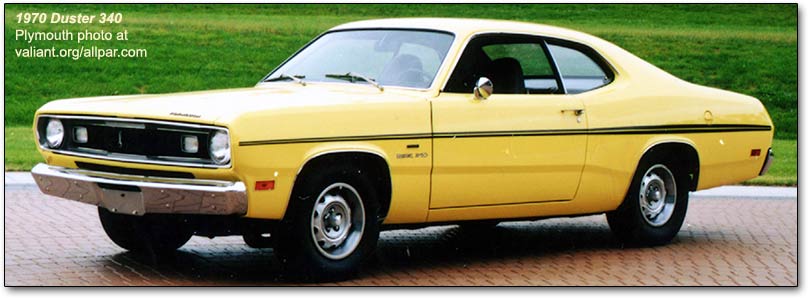
When the Valiant line was new, it spawned a sporty version called the Barracuda. After a few short years, the Barracuda was spun off onto its own body type (E). Splitting the Barracuda off left the Valiant line without a sporty body style for a few years - until the Duster was dreamed up.
The time from conception to production was astonishing, and the Duster was incredibly popular for its entire run. Curtis Redgap, former police officer and son of a Plymouth dealer, tells the story of the Duster's development. It should sound familiar to those who followed the creation of the PT Cruiser or Australian Charger.
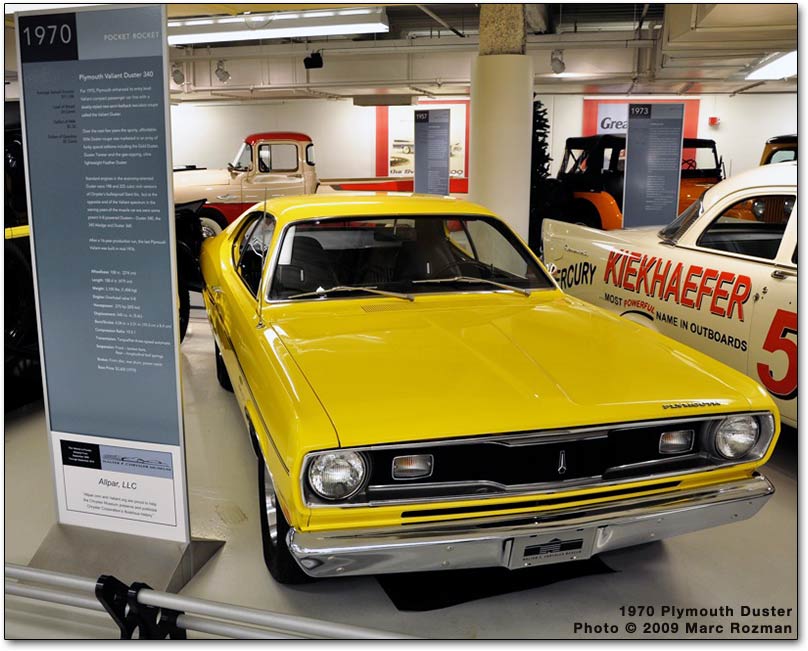
Duster: The Plymouth That Almost Wasn't (by Curtis Redgap)
The Cannonball Run in a Duster story evoked many memories for me. That same week, one of my friends at work took me totally by surprise by asking me if I knew where he might find a 1970 Plymouth Duster 340 for sale. Both of us had bought 1970 Duster 340s with cash in October 1969. Both of us had stopped at the dealership on first sight, had a good laugh at the moniker, and chose blue “sleepers” with no outward indication that one of the best performance V-8s Chrysler ever built resided under that hood. The only clues were the road rally wheels, Polyglas 70 series tires, and the twin exhaust outlets that were barely discernable behind the rear bumper.
Origin and development of the Plymouth Duster
To understand the Duster, it helps to know something about the Valiant. In the mid-1950s, with sales essentially guaranteed by a booming economy and the wartime production stoppage, Detroit became arrogant. Cars were made heavier, costlier, wider, gasoline hungry, and chrome laden — to many customers’ delight — with soft suspensions, lousy brakes, and planned obsolescence. However, the increasing growth of import buying got Detroit’s attention. By the mid 1950s, German and Japanese imports were garnering over 670,000 cars a year. That much of a sales loss could no longer be ignored. Detroit automobile executives grudgingly ordered smaller cars into production.
With much hoopla and fanfare, each major car company in Detroit introduced their own concept of small cars in the fall of 1959. General Motors brought out the Corvair; with its rear engine, it was what the General felt should be the American Volkswagen. At the end of March 1969, the Corvair was gone. Unresolved design flaws at its introduction brought the wrath of Ralph Nader down on General Motors, which reacted by spying on Nader, while John DeLorean worked to fix the inherent safety problem. DeLorean was successful but GM did not publicize the change. During my stint in the United States Air Force, I owned two Corvair two door hardtops, and I experienced none of the so called handling deficiencies that Nader claimed made the cars unsafe at any speed. The minor flaw in the engine was the tortured path of the cooling fan belt. I kept a spare in the trunk at all times. Only once in the many seven hour one way week end trips to home from my assigned base did I ever have a belt break. Five minutes to slip a new one on and away I went again.
 Ford brought out the Falcon. It was a shortened, shrunken down Ford. It had a coffee grinder of an engine and was totally conventional. It sold scads of cars for Ford, with an almost unbelievable first year run of 435,676 units. Early models were cheap, and unfortunately, they behaved cheaply too. Rust was a major plague. Industry wags said that the Falcon was the first wholly designed “throw away” car, meant to be built cheap and then forgotten after a couple years. However, by 1969, the fresh faced Maverick was waiting to take its place, just off stage. The Maverick would not prove to be the most reliable or durable car, but it was light, cornered very well, had a nice ride and quiet interior, and the performance was sprightly enough.
Chrysler introduced the now almost-legendary Valiant in 1960. With corporate chaos reigning supreme, the company elected to not have it come out as a Plymouth model. Instead they intended the Valiant to become a brand of its own, with its own stores and corporate division. Somewhere within the scandals and charges of sweetheart supplier deals, someone realized that had the corporation included the nearly 200,000 new units in the 1960 totals, Plymouth could have hung on to its usual third place finish. So, in 1961, the Valiant was officially a Plymouth.
Mechanically, the Valiant was as conventional as the rest of the corporate lineup, aside from the new “slant” six and the first use of a Chrysler built alternator. It also had a smaller, lighter, better designed Torqueflite transmission that included, for the first time, a lever beside the push button controls that set mechanical fingers into the output shaft for a “Park” position.
 |
 |
 |
What set the Valiant apart was the Virgil Exner-inspired exterior design and the superior cornering. He was determined to achieve a look that was unlike any other car, even any other Chrysler car. He borrowed from the concept cars that constituted his early ideas that inspired the Chrysler K-310, the DeSoto Adventurer and the Chrysler d’Elegance.
The Valiant had no fins! That coming from the man that brought fins in at Detroit. It was an extremely pregnant moment to recall the Valiant style. Mr. Exner had a spate of these designs in progress in a locked, totally secret studio, whereby he intended to overhaul all the corporate cars for 1962. As we know now, with the heart attack that subsequently incapacitated him, along with foolish corporate jealous infighting, those designs never coming off anywhere near where he intended.
 |
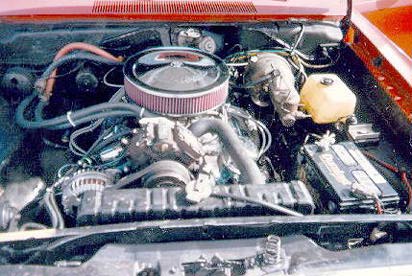 |
So in the fall of 1969, of the three small cars introduced in the fall of 1959, only the Valiant truly remained. A good thing that, because Valiant’s best days are still to come!
Chrysler Corporation, in the mid and latter part of the 1960s, regularly garnered over 30% of the compact car sales. This, at a time when the average of all compact car sales stood at 16%. The Plymouth Valiant and slightly larger Dodge Dart were economical, inexpensive, attractive, dependable, and cleanly styled. They also held decent resale value, making them good trades which resulted in desirable used car sales. Over the course of the 10 year run for the Valiant, it had been restyled twice. Once in 1963, and then again in 1967, when the wheelbase was pushed out to 108 inches.
With that 1967 restyle, Valiant surrendered its sportier models, the notchback two door hardtop and the convertible body, to the sexier stable mate, the Plymouth Barracuda. 1968 and 1969 sales years were excellent. Plymouth stylists had to be content with very small styling tweaks on the product.
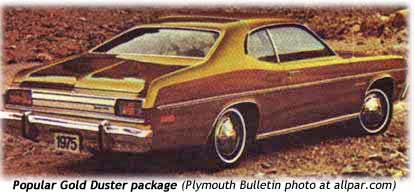 1970 models were focused on the new “E” bodies, which were the larger, stronger Barracuda and Challenger model from Dodge. The corporation focused on these because they were betting that being able to stuff the largest V-8 engines such as the Hemi 426 into these new “pony” cars would yield great cash results in the youth market. The current Barracuda was just not quite ever able to run with the Ford Mustang or the 1967 Chevrolet Camaro. Off to the usual slow start, corporate executives were quite nervous about the models, whereby they needed them to be huge hits when they came out. That meant, of course, that the Valiant was way below the corporate radar.
With such an effort going on, corporate planners realized that all the car lines needed a freshening. Not a redesign, but, a make over of sorts to recall the stylistic beauty of the current Chrysler cars. At the end of the model year 1969, thirty million dollars was set aside for a make over for the Valiant, and Dodge Dart. This was to be split evenly between the two divisions.
There were some things going on in the background that lead to the decision about how that money was going to be spent. Plymouth well recognized that with the loss of the sporty body styles to the Barracuda, there wasn’t much left to bring the youth market to the Valiant. To further give pause to thought, Chevrolet had dropped a 327 ci V-8 into its two door Chevy II Nova. It had been a hot number right out of the box. By 1969, a 350 ci V-8 was available in the Nova SS, rated at 275 horsepower. They were inexpensive, and the kids were buying them up.
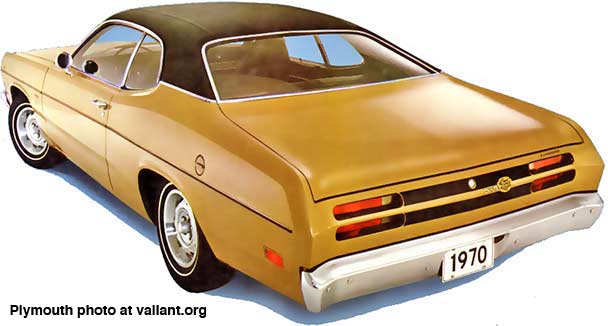
To compete, Plymouth would have to use a compact body. Given the dowdy body style of the current Valiant, even dropping a 340 V-8 into it would not bring the kids to the front doors of Plymouth dealers, and Dodge already had the compact Dodge Dart Swinger 340. If Plymouth were to compete against the Chevrolet with any success, a new body style was needed.
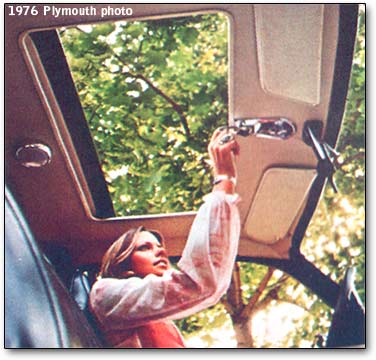 The major problem was that there was no new body style authorized in the Long Range Plan for Plymouth. The LRP is the main book of corporate entity. If it isn’t in there, then it just isn’t. Not to say that the Plymouth people were not up to the challenge. They knew, of all, the best thing for Plymouth. The same sort of corporate mentality existed in the mid 1950s when the 1955 Chrysler 300 knocked everyone into the weeds.
Quick to capitalize on the 300 image, DeSoto and Dodge were both authorized performance cars. Plymouth was informed that a performance image didn’t fit into the LRP as Plymouth as a family transportation type of vehicle. Taking matters into their own hands, the good folks at Plymouth built the 1956 Fury. It went on to be a big name for the company, and a hit for Plymouth. So, I suspect that there were still some of those folks around the Plymouth hallways in 1969. They knew what to do. Just because there was no one to say to the Plymouth folks that they could build a new model, it also meant that there was no one saying that they couldn’t!
The situation wasn’t dire, but $15 million is extremely tight to bring in a new model. To save every single penny for tooling costs, anything that could carry over from the Valiant was not changed: the wheelbase, front end sheet metal, cowl, front and rear bumpers, quarter panel inserts, and running gear. Given that, the stylists were given free rein to come up a neat looking two door to compete against the Chevrolet Nova coupe. This car had to ride on a carryover floor pan, chassis, wheelbase, and even the overall length, had to be the same as the Valiant. It had to be done quickly. Getting tooling machines on line for production takes a long lead time, so the body had to be in place just as soon as the styling folks got it together.
One of the people in charge of all this was Gene Weiss. He openly conspired with Plymouth stylists to bet $15 million on a long shot model not approved by corporate management. It was not even on the horizon.
Why take the chance? He, along with other engineering and planning executives in the Plymouth division knew that unless the potential buyer opted for the huge (over $1,000) investment in the Hemi 426 engine in the Barracuda, it was not as fast as it needed to be, so it was not going to get the job done! They were too heavy. It was obvious that what was needed was a really attractive, but lighter weight compact with that high performance 340 in it. They had such a combo in the departing 1968-69 style Barracuda. Dodge, of course, had their light Swinger coupe with the 340 in it, which made for very swift competition to anything on the street.
Weiss and his team knew that the style of the current Valiant, even with the 340 in it, was not going to sell. That is how the decision to invest not one single penny in freshening up the Valiant was arrived at. Looking around, Mr. Weiss settled on a stylist named Milt Antonick. He was labeled as an expert at making something of value out of what was available. Insiders call this technique “junk yard” styling. At the time, Mr. Antonick worked as a supervisor in the compact and pony car exterior design studio. Milt called upon a junior stylist who had been working on the full sized Plymouth to make some sketches.
Neil Walling recalled that it had to be done quickly. He dropped everything else, and within a couple days had what turned out to be the basis for what was to become the “Duster.”
 What set the entire design sketch off was the slope back rear, wide bustle like rear fenders, metal crease lines that fit perfectly with the Valiant that fell off dramatically above and below the full open rear wheel well, along with the almost tiny, “postage stamp” roof. The fit of the small roof did make the car, especially in the sweep of the large “C” pillars. Yet, with all good things, Within that design, came the largest bugaboo. It called for really curved side glass in the door windows. [author’s note: I recall very clearly just how curved those windows were, when in the winter or when raining, opening the window meant a soaked shoulder!]
In 1957, working closely with Pittsburgh Plate Glass (PPG), Chrysler managed to scoop the industry with the introduction of 90 inch radius curved side glass on the Imperial. Ten years later, 90 inch radius curved side glass was made a part of the 1967 model Valiant and Dart. Relatively speaking then, no design improvements had been made since 1957. What Mr. Walling proposed in the yet unnamed car was even tighter curved glass. Mr. Walling wanted to double the radius to 45 inches! True, it made the design work, but stood to become an engineering nightmare. You must recall that this heavy curved glass window had to fit within the existing Valiant door!
Nothing else could be done to avoid having to go outside the small group of conspirators. A car engineer had to be consulted to resolve the window glass issue. Mr. Weiss choose someone that he felt wouldn’t run to management and blow the cover off the project before it really got started. Mr. John Worthy labored in the Advanced Car Engineering Department. He was brought in under the guise of studying what purportedly was a design “proposal.” Not realizing at first that every word he uttered was being taken for positive proof that such a design could be accomplished.
Mr. Weiss finally made the assignment clear. When Mr. Worthy realized he had been “had”, and that he had been given an assignment going out beyond the corporate mentality of the LRP, he was mad as hell! He felt used as well as having had his position placed in jeopardy should it all go south with a corporate edict that the car and everyone involved was “dead.”
Realistically, it was a tough job. It had never been attempted. And the curve was enormous for a compact car door! The original design was meant for a flatter glass. You had to stuff 45 inch radius curved windows down inside a door not designed for it, and then make them go up and down flawlessly.
Perhaps it was being made angry, feeling used or threatened, or maybe he wanted to get it done and get away from the project before it blew up in every one’s faces. Whatever it was, Mr. Worthy did it! He made the 45 inch curved glass work inside those 90 inch curved glass designed doors! And inside a couple of days! Singularly, and beyond all doubt, without this, the car would never have been.
Milt Antonick felt that the side glass was too curved. It was too close to the driver’s head. Yes! — but it was such a good car, such things were just acceptable. Applying such a curve dramatically increased the round look above the belt line, sweeping away the “made from Valiant parts look.”
 Other flaws cropped up later in the model run. Out back, in the rear panel, the tail lights were set directly in the metal, without any bezels around them; they quickly became a spot for rust through. The rear panel resulted in a high lift over to put things in the trunk. The flat deck lids had no handles to for closing; owners took to closing them by slamming them with their hands on the lip, resulting in creases or small dents very quickly. The Plymouth team rushed a redesigned lid into production that had a strengthening vertical rail down the center real early in the 1971 model year run.
The only flaw to pure poetry of the standing still appearance came in the size of the rear axle track. Mr. Walling was stuck with the Valiant rear end. It was about 2 inches too narrow on either side to coincide with the sketches. It didn’t stop the group by any means. Those things were not even taken note of by the huge majority of owners.
The arrival of the name for the car itself is story on to its own. The 340 ci V-8 was the basis for its existence. This was one of the highest performance V8s ever built in the corporate line. Rated at a very conservative 275 horsepower, most insiders readily concede that it had more like an easy 320 or better. The corporate boys went nearly into shock when the proposal to use the 340 in the Duster was presented. Gene Weiss recounted later that meeting was “traumatic.” Perhaps the reason was that the Duster proposals showed it to be a very quiet “sleeper,” contrary to the current round of wild graphics that loudly proclaimed what the car was. Lulled into believing that Plymouth was just going to build another people kind of transportation car, some of the corporate types hit the roof when the real rationale for the Duster came through.
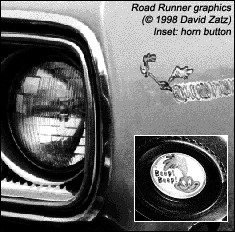 With the success of the 1968 Plymouth Road Runner, characters proved that they would sell, and that a corporation had a sense of itself along with tongue in cheek humor. Only Plymouth could have pulled it off, and they did with that car. Milt Antonick certainly had a sense of humor. He drew up a very small image of a telephone booth with the door left slightly ajar. Below the image he put the letters “C K.” They stood for Clark Kent, the disguise for Superman. Then if you had any doubt at all, when you opened the hood he had allowed for a big 36” by 36” emblazoned Superman “S” to cover the engine silencer pad. It was a wonderful concept. Great humor, and out right fun for the hell of it. In fact, all the rights to use the character and symbols had been secured from the DC comic company.
But with the sort of entrenched mentality that eventually ruined Plymouth, the Chrysler-Plymouth Division Assistant General Manager threw a fit about it. Several sources reported that R. K. Brown thought it was the most ridiculous concept he had ever heard about. He just could not grasp what a telephone booth had to do with marketing a car.
This was after the original concept of using the Tasmanian Devil swirl from another Warner Brothers cartoon character had failed. Unable to secure the rights to use Tas and his swirl, the designers created their own devil or “DUSTER” swirl. It followed the concept name that came out of an advertising agency suggestion. It sounded performance oriented, and had a bit of humor in it. After all, when you got beat, you had been “dusted.” The Duster CK died, instead becoming the Duster 340.
The money had been spent. From sketch to tooling, it had taken all of six weeks! Corporate officials may have been upset, but the Duster program was in place. Plymouth division heads were highly confident. So there would be no mistake, the 1970 model was titled as a Plymouth Valiant Duster. This would change for 1971, when the Valiant part was dropped. Vile rumblings from Corporate in Highland Park aimed in the direction of Plymouth directors would soon be blown away in congratulatory hand shakes and joy of increased profits.
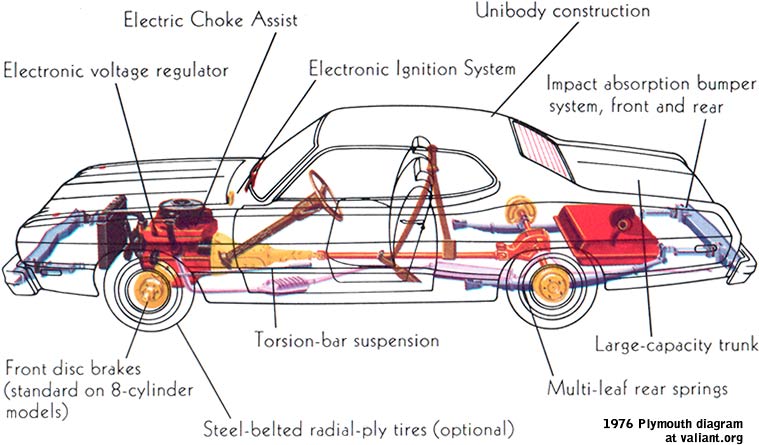
Duster was based upon the solid Chrysler engineering of the time. Unibody construction, front torsion bar suspension, Torqueflite automatic, four engine choices, disc brakes as an option, wide color selections, full bench or bucket seating, and full instrumentation complete with an optional tachometer. Best of all, the high performance 340 V-8 had a new fast moving home. It instantly became a member of the Plymouth Rapid Transit System. Out of the box stock, it ran a 6 second 0 to 60 time. It could reach 130 miles an hour, and could pull a 14.5 second quarter mile at 99 miles an hour. That was within the territory of the 440 V-8-powered B-bodies.
Duster vs Valiant
The Duster had a somewhat smaller rear seat than the Valiant, but had over three cubic feet of additional storage space, thanks partly to a higher deck lid. The rear window was curved more aerodynamically, possibly as a result of wind tunnel tests done on cars designed for racing. The Valiant still had a 108” wheelbase in 1970, when the Duster was introduced; the front legroom of the 1970 Valiant was 40.8 inches (rear legroom was 35.4).
| Valiant | Duster | |
|---|---|---|
| Wheelbase (1970-73) | 108 | 108 |
| Wheelbase (1974-76) | 111 | 108 |
| Width | 71 | 71.7 |
| Height | 54 | 53.4 |
| Headroom | 38.3 / 37.3 | 37.2 / 36.4 |
| Legroom (1970-73) | 41.5 / 34.7 | 41.9 / 29.4 |
| Legroom (1974-76) | 41.9 / 35.2 | 41.9 / 29.4 |
| Trunk - cubic feet (1970-73) | 14 | 20.1 |
| Trunk - cubic feet (1974-76) | 16.6 | 20.1 |
The Plymouth Duster hits the showrooms
On September 23, 1969, the new Duster went on sale nationwide.
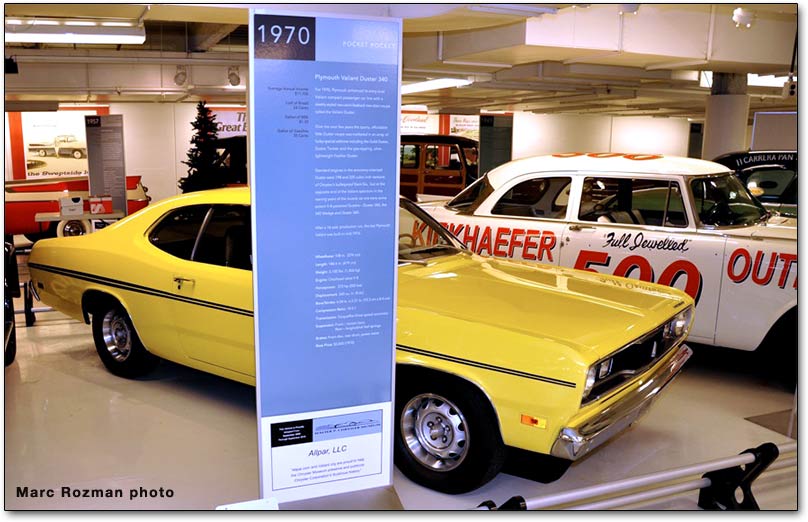
 Car Life rated the 1970 Duster 340 with a 3-speed TorqueFlite automatic in their March 1970 issue. They obtained a 6.2 second 0-60 time, with 0-100 in 17.5 seconds, incredible for the tire technology of the time. Quarter mile time was 14.7 seconds @ 94 mph. Overall gas mileage was 14.8, quite good for the performance and the time. Weight was 3520 lb as tested, price $2547.
Some car testers panned the handling, saying it tended to understeer. My friend and I never found a situation whereby the Duster failed to go where we asked it to go. Perhaps on the race track, pushed over the limit, such things would show up. In the real world, even at triple digit speeds, the Duster was every bit as competent as anything on the road at the time. I was well into police cars, and a 340 in the hands of a confident driver would not be a car that I would like to have to try to catch, even with another MoPar.
On the way home on a Friday evening, I swung by my Dad’s former dealership. The model year introduction had been the previous week. Right out front, sitting high, mighty and handsome, was that beautiful blue Duster. I went no further in my old trusty mount, a 1959 Plymouth Fury that had done me well.
The style got me in the door. The test drive was all I needed. With the money I had saved during my stint in the service, I paid cash for the 340. The invoice had an MSRP of $2,679. With taxes, title and dealership fees, the total was about $3,200. I rolled it over the curb and drove it home for $2,800 cash. I spent the weekend just riding and cruising.
The performance blew me away. My 361-powered Fury was no slouch, but this 340 was like a shot. Many 351 Mach I Mustangs found out just who the “boss” really was. I never met a stock Nova that I couldn’t “dust,” even with the SS 350 V-8.
During the first week of ownership, I drove it over to my parent’s house one evening to eat dinner with them. My father congratulated me, delighted that I had made such an economical choice. He did not realize that it had the 340 thumper engine in it — until I started it up to go home. He had walked outside to see me off. He was genuinely astonished at the large V-8 dual exhaust notes that came from under the car. In the idiom of the day, his only remark was “good gawd, a damned racin’ machine”!
Interest in the car was very high at the department. Several other officers got Dusters of their own. It seemed that there were everywhere. And in fact they were. Just about everyone had one. Or their neighbor did.
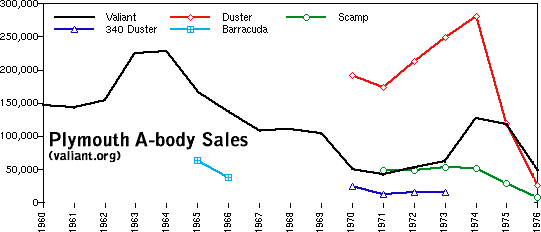 At the end of the model year, Plymouth had sold an incredible 217,192 Duster cars — a huge increase given that in 1969, they had sold just 36,317 two-door Valiants. When the 50,810 four door sedans were added in, Valiant broke its previous sales record with a 1970 total of 268,002 units. Duster would score five more sales records before the end came in 1976.
And why not? At a base price of $2,172, the Duster represented a fantastic car for the money. Compared to the Ford Maverick, the Duster had a five inch longer wheelbase, 4.5 more cubic feet in the trunk, 11 inches more hip room in the rear seat, 3.5 inches in the front, bigger brakes, more options to choose from, and had a far better warranty. Quick to capitalize on a good thing, after selling 100,000 units, Plymouth turned out a Gold Duster option package. It was a dressed up version, although it fell somewhere less than the full boat 340. It was designed to turn “prospects” into “prospectors.” The buying public was captivated by the advertising and pushed sales ever higher.
The Dodge Demon joins the Dodge Dart Swinger
 1971 brought some changes. Changes for the Duster 340 included a huge Carter Thermo-Quad carburetor, new front-end styling, twelve new colors, and a new side tape treatment.
Seeing the fantastic run made by the Duster, the Dodge division began demanding that it be allowed to market a Duster equivalent of its own, in light that the 340 Duster sales were nearly double that of the Dodge Dart Swinger 340. A top-level management decision ensured that Dodge got what it wanted.
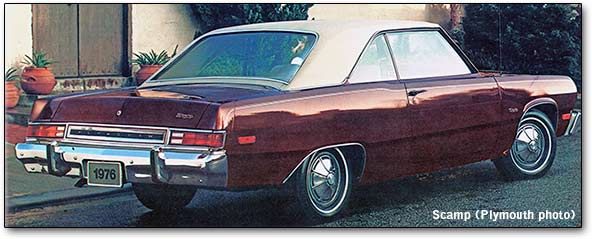
This time around, Plymouth had a stick of its own in the fire. It demanded that it be able to market a car similar to the Dodge Dart Swinger coupe. Plymouth named it the Scamp, giving it a longer wheelbase car that had the appearance of having more luxury.
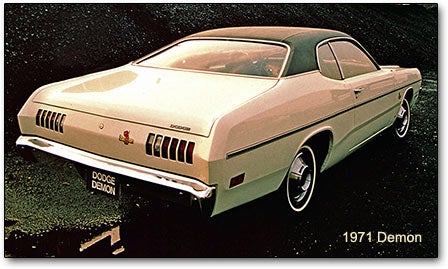
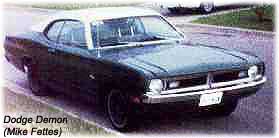
Everyone remembers a winner, but no one recalls who came in second. The Dodge-type Duster was given a name of Demon, with a little cartoon character that looked like a little devil with a trident. The religious coalitions went wacko about that. The rest of the car was essentially a Duster clone, with engines starting at the 198 slant six and moving up to the 340; the front end was taken from the Dart, while the rear had vertical cuts in the metal for tail lights (thanks, Mike Fettes).
Demon sales only hit made about a 40% total compared to the Duster; but in its first year, Scamp turned 48,253 people into Plymouth owners. That amounted to a 48% of the sales of the Dodge Swinger. Both figures must have given the Plymouth folks smiles of satisfaction.
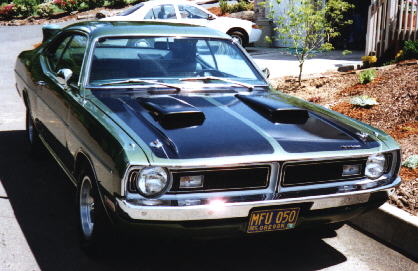 | 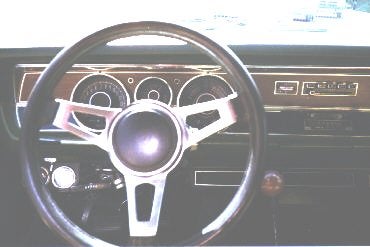 | |
| "Gazguzlr's" Dodge Demon, inside and out | ||
(Dana Atchley wrote that the 1971 Plymouth Scamp’s front and rear fender lights are set in a recessed metal frame and in 1972 and later, they're plastic elements screwed to the side of the fender. The taillights in the bumper were one tail/brake lamp per side on 1970 Dodge Swingers and 1971-73 Plymouth Scamps, and two tail/brake lamps per side on 1971-1973 Dodge Swingers.)
Road Test looked at the 340 Dodge Demon automatic in April 1971. They got 0-60 in 7.8 seconds (a more typical time) and a 14.6 second quarter mile at 96 mph. Estimated top speed was 127 mpg, fuel economy about 15-16 mpg. They rated the cornering, finish, luggage space, performance, and steering to be excellent.
Owners of the Duster and Demon had some advantages over owners of Swingers and Scamps; the rear of the Duster was designed for aerodynamics, and greatly reduced noise and increased highway gas mileage. Cruising became easier. The high deck lid also dramatically increased trunk space, giving coupe owners far more storage than sedan owners.
 |
 |
The Plymouth Duster Twister
Keeping up interest, with little tooling allocated for changes, Plymouth developed another package. Calling it the “Twister”, it was a clever take off on the Duster theme. It ended up being a car that looked just like the Duster 340, except it didn’t have the 340. By the end of 1971 the Duster had turned the Plymouth division into a winner, garnering some 277,331 sales on the Valiant side of the house.
1972 had been planned for an all out complete makeover for the compact cars. The stylists had gotten to preparation for softer, rounder Darts, Demons, Dusters and Valiants. The decision had been made in 1970. At that time, there wasn’t much money to go around, so the decision had been that there would be no allocation for the 1972 models. It didn’t make much difference to the public. The cars were so popular that they just kept on selling, just as they were. They owned a 30% share of the compact market, twice as large as any other competitor.
The largest change came in the engine department for the 340. Compression was reduced to 8.5:1. The horsepower was now measured by the SAE standard, drawing the 340 to 240 ponies. By the end of the 1972 model year over 330,393 folks had bought cars from the Plymouth Valiant contingent. More than ever, the Duster was just all over the place.
The Dodge division gave in to the hue and cry from the religious coalitions and changed the Demon to the time-honored Dart Sport. It still never sold anywhere near the totals of the Duster.
I bought a second Duster for the significant other in my life. A big six automatic. It was the first totally new car she had ever had. It was of course, for me, the second. Long after we had parted company, she kept that car. It just seemed to go forever.
Styling changes to the cars for 1973; the Space Duster
 The 1973 model year saw some styling changes, though they were minor in nature. The taillights were revised, and a new grill and bright work were added. Engineers came up with a means to allow the rear seat back to fold up, allowing a complete pass through. This became the Space Duster.
The new grillwork also made for a new hood shape that featured a bulge in the center piece. It looked more aggressive. The front bumper was restyled to meet the new Federal standards; the application on the Duster looked far smoother than the larger cars did.
While the word had gone out that performance was dead, and insurance companies conspired to aid in its death with usury rates, the Duster 340 sold 15,731 copies this year, the most ever, but that was the high point for the high performance Dusters. The number crunchers hadn’t gotten around to figuring out just how fast the 340 truly was, keeping the rates out of the skyrocket column.
Gasoline availability did more to knock off high performance V-8 engines than anything else. It wasn’t the price per gallon, it was whether you could get it. The OPEC conspirators and obliging oil companies jacked up prices and withheld deliveries in all areas of the country. I had friends that bought their gasoline in Canada; finding fuel was never a problem, nor was the price. The oil crisis seemed to be a complete fabrication and manipulation of the American market.
 In that environment, I got my third Duster. I told myself that I would save gasoline with it. It was a 1973 model that had been confiscated in a drug raid by the State Police. With a bit more than 6,000 miles on the odometer, it had been modified from the original. It was painted Hemi Orange. Someone had invested pretty good in modifications to the 225 six. It had been made over to the Hyper pak with a tuned intake manifold and Carter AFB four barrel carb. The exhaust had a set of 180° Hedman stainless steel headers on it. The camshaft had also been changed, although to what extent I don’t know. The suspension had been attended to with heavy control Bilstein shocks, and wide radial tires. As well, the rear brake system had been changed to an after market set of disc brakes. The transmission was a four speed stick on the floor. It did have power steering and brakes. The interior was black and included bucket seats. Otherwise, it was fairly stark.
The State Police regularly auction off items they “collect”. I attended the session when the Duster came up and walked away with the winning bid. With their paperwork, I was able to get a new title to the car in my name.
That was indeed my favorite Duster. The big six just seemed to turn and turn and turn. The exhaust, which was a three inch affair, snarled when you got into the four barrel. A great soul soothing sound. The suspension modifications truly made a road racer out of the car, and many a Corvette driver was astonished when they couldn’t shake that Orange Plymouth on the twisty bits of highway. No, it was not a fuel efficient car. It loved gasoline through that big four barrel. But, towards the end of 1973, the oil companies had gotten the price of gasoline up to around seventy cents a gallon, so availability suddenly was no longer an issue.
The end of the 1973 model year saw another record, with 380,592 registrations for the Plymouth Valiant Duster division. Smiles all around again.
1974: Valiant Scamp becomes the Brougham; luxury pushes out sport
1974 was another banner year for the Duster. Buyers continued to come into the Plymouth dealers in high volume, driving away every Duster that could be built. Style wise, the 1974 was a pass. No major changes at all, except under the hood. The 360 cubic inch V-8 was introduced to replace the 340.
Originally conceived as a smog motor, the 360 was a great performer. In the Duster it made for 245 horsepower. It only had the Torqueflite transmission available. [Don wrote in to say that he does have a Hurst four-speed stick-shift 1974 360 Duster with original documentation. It’s possible it was offered for only part of the year or in certain regions.]
This was my third totally new car. I traded the original 1970 340 for a 1974 360. The 360 was just as hot as the 340. It was a screamer. Gasoline prices and insurance rates had been making a big impact, though, and only 3,979 Duster 360s were sold.
Styling had gussied up the Valiant Scamp, turning it into something called a Brougham, and people went nuts for it, snapping up 127,430 copies. It pushed the Plymouth division into an easy third place win in the production race. Total assemblies amounted to 476,818 cars!
Never great sellers nor anywhere near the performers they were expected to be, Dodge Challenger and Plymouth Barracuda production ended in April 1974. The original concept for the 340 Duster had been the correct answer. The original Barracuda had also been the right car, had it been allowed to evolve within the Plymouth division; it would probably have ended up being very similar to the Duster.
The last Plymouth Valiant Dusters: 1975 and 1976
Word got out early about the planned replacement for the Duster and Valiant. Chrysler wanted to have compacts that would compete on an upscale image as opposed to being basic transportation. Their decision was reinforced with the Brougham model; people couldn’t get enough of them, and the added options (and price) made them profitable.
Chrysler had, by early publicity, given people a reason to not make that buy. The car was good enough to wait until the new models came out in 1976. You could see it with the end of the model run. Figures fell to 267,525. A large number of those were the upscale Valiant Broughams, which fuel-efficiency minded customers, used to the luxury trim in their big Fury or Monaco, could buy without a qualm. The 360, upon which the Duster had been originally conceived, only sold 1,421 units in 1975, and was discontinued at the end of the year. Find one of those and you have a very rare MoPar. The writing was on the wall.
The end finally arrived in 1976. The press fell in love with the Plymouth Volare and Dodge Aspen. Motor Trend Magazine named them the “Car Of The Year” for 1976. With all the uproar, it was easy to forget that the Duster was still around for 1976.

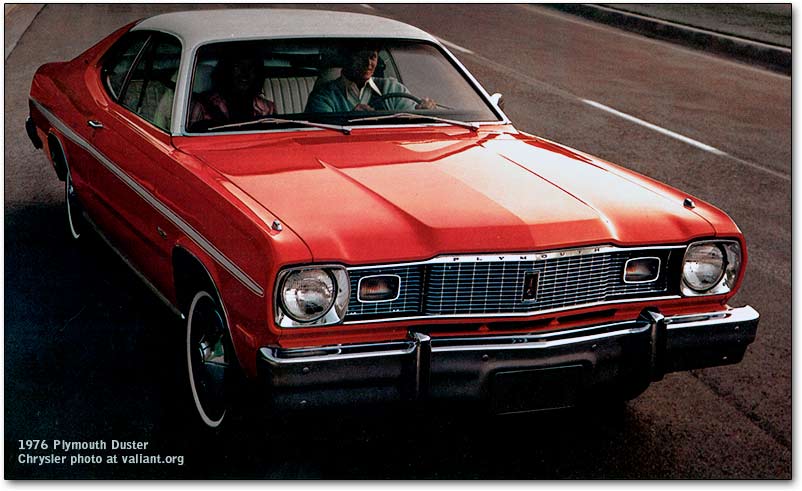
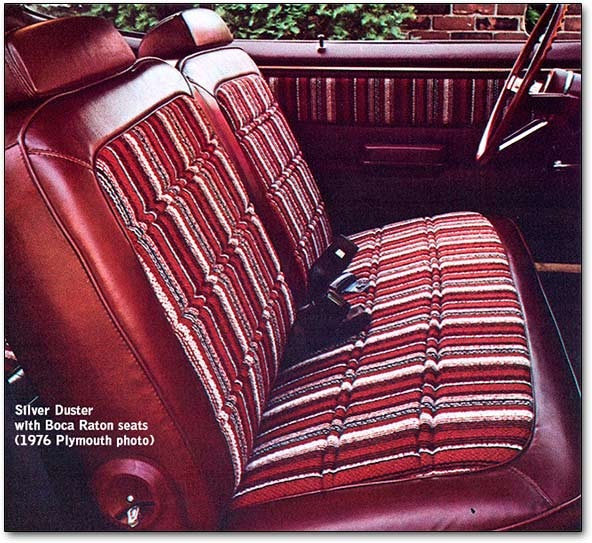
 Hidden among the Valiants, the Duster garnered 34,681 sales that would not come back to haunt Ma Mopar. Two surprises included the Silver Duster package, an appearance and trim scheme, and the more popular, more memorable Feather Duster.
The Feather Duster included aluminum replacements for the inner hood, trunk bracing, bumper brackets, and intake manifold, cutting weight by 180 lb (around 5%). It had a smaller single barrel carburetor, economy distributor calibration, large exhaust, and a 2.8:1 rear axle ratio, with a choice of three-speed automatic or four-speed overdrive manual transmission.
While acceleration was compromised, the Feather Duster was now rated at 22 mpg city, 31 highway with the automatic (a stunning 24 city, 36 highway with the manual), and was larger inside than many other economy cars, though acceleration took a hit. The Feather Duster was a fine alternative to the extra-slow Japanese imports that customers were waiting to buy, at list price; or at least it would have been, had more people considered it over the quick-rusting Coronas, Civics, and Datsuns of the time.
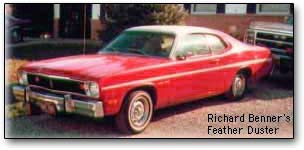
The Feather Duster could be well optioned — Richard Benner’s (pictured) had styled Rally wheels, a vinyl top, bucket seats with a console and floor auto shifter, full carpets, and all the other options.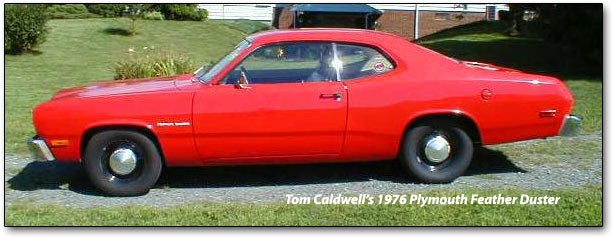
In its August 1976 issue of Car and Driver, editor William Jeanes reported on a one-off show car built by the good folks over at Plymouth and called the "Fonzmobile." Based on a Duster 360 coupe, the Fonzmobile was built to capitalize on the popularity of the television show "Happy Days." The car featured a flame paint job, lakes pipes exhaust running under the body sill, dummy dual spotlights, wide whitewall tires, baby Moon hubcaps, a fold-down rear seat and a sliding sunroof. At the time, no plans existed to build such a car for public sale. The idea was to entice owners of the 1,173,000 used Dusters and Darts on the market to modify their own cars in similar fashion. (This paragraph was from Jim Benjaminson writing in the Plymouth Bulletin, reprinted by permission.)
Finally, like all good things, the end arrived. The Duster went quietly away. Most analysts felt that Chrysler could have kept right on marketing the Duster for years without major alterations.
It had been a great run. A stunning 1,328,377 Dusters had been assembled in just seven years — not bad for a car that was not supposed to be produced.
Additional Plymouth Duster notes
The Duster name would outlast the Valiant, with versions appearing on the Volare, Horizon, and Sundance.
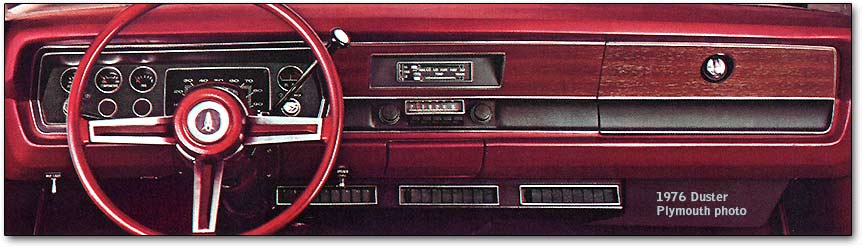
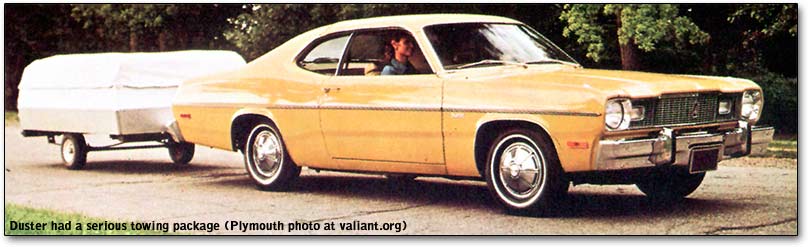
The overall height was 52.6 inches, headroom (front) 37.2 inches, wheelbase 108 inches. The large trunk had nearly 16 cubic feet of space, hidden neatly by the styling. The interior was borrowed directly from the Valiant, as one might expect. The base price of $2172 bought a very basic model with a three-speed column-shifted manual transmission and no power assistance, which made the brakes and steering into exercise equipment; few decided not to spring for power brakes and steering. This was only a little above the base price of the original (1960) Valiant.
Plymouth Twister
Dave Duricy wrote that the Plymouth Duster Twister option package cost $100 and included a large variety of trim and stripes, but did not include any engine enhancements - a sheep in wolf's clothing.
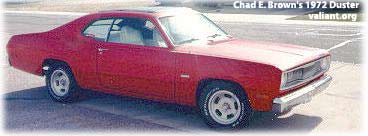
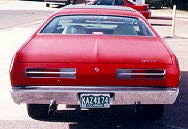
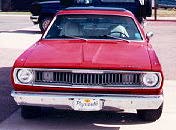
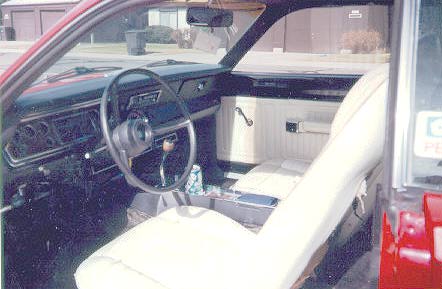
Chad E Brown, a 1972 Twister owner, tells us that a Twister is a Duster with certain options standard, including bucket seats. The Twister also had a little cartoon tornado with eyes on the back panel near the taillights. First started production mid 71, when it had Rallye wheels, racing mirrors, side and lower deck stripes, flat black hood with Swinger 340 hood scoops and a unique 340 grill, standard. Biggest motor available was 318. 1972 models were the same but had standard bucket seats, Rallye wheels, and racing mirrors. The Twister lost the cool hood this year too. Also available was a canopy top and other stuff (inside hood release, etc...)
Jesse Moser wrote: "the Twister package changed to match the new body style of the 1973. The hood stripe follows the top edge of the "power dome" on the hood, and the late 1960s Formula S type scoops were added in place of the larger 71-72 scoops. A rear panel stripe was also present, though the cartoon disappeared, which by the way was only used on '72 cars. Bucket seats are no longer standard, since mine has a full "deluxe" bench. The Rallye wheels should be free of trim rings and a front anti-sway bar should be underneath. All of this should also be true for the '74 Twister, the last year for the option.
Steve Brown noted that, in 1972, the Twister Package was the A51 Accessory Group (option package) and consisted of body color dual racing mirrors, drip rail molding, wheel lip molding, performance hood treatment, and strip (body side tape with slant six, lower deck tape stripe and Twister decal with V8). The drip rail and wheel lip moldings and the Twister decal were only available as part of the Twister Package. Steve received this information from Galen V. Govier.
Volare Duster
The Duster name continued after the North American debut of the Plymouth Volare; essentially, a curvy rear was given to the “formal look” Volare, though the treatment was not as strong (and not as effective) as on the Valiant.

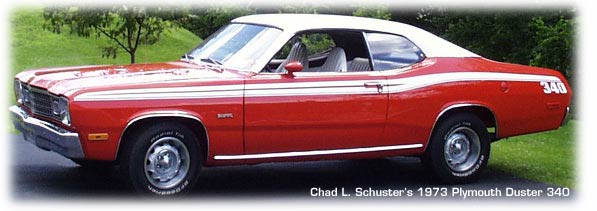
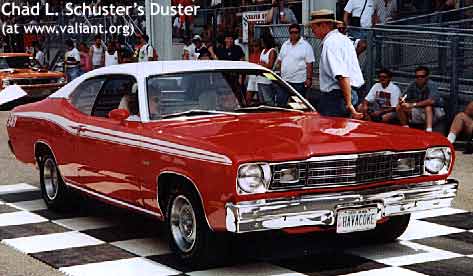
Chad Schuster’s Duster
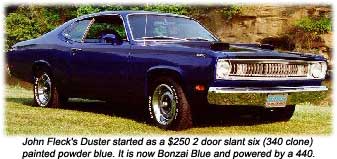
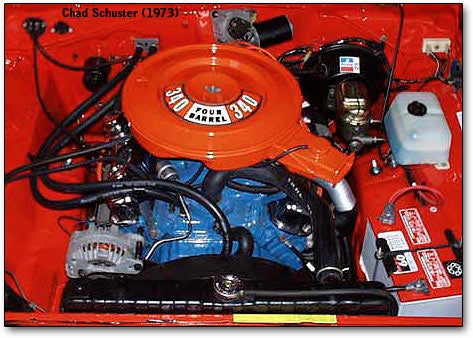
Chad Schuster's 1973 Plymouth Duster has matching numbers, a 340 engine and A727 heavy-duty automatic with floor shifter. In the fun field participant judging he received 2nd, 3rd, and 1st prize in the 1998, 1999, and 2000 Chryslers at Carlisle shows. It was featured in the December 1998 issue of Mopar Muscle. Since then, Chad installed an original style battery, NOS tail lights and bezels, NOS three-speed wiper motor, front license plate bracket, black crankcase breather, and reinstalled a factory AM/FM radio. Many other details have been updated to match the correct factory condition. Some key features are a fold down rear seat, rocker panel molding, and factory chromed/argent silver grille.

 Your Privacy Choices