
Chrysler Valiants, Valiant Chargers, Valiant Pacers,
and other cars of Chrysler Australia
Hey Charger! the book (Alternate Source) | Reviews of Australian Valiants | Hear Graham Pratt's 265 Hemi | Australia’s Chief Engineer
 The Valiant remains prominent in Australian motoring history, a testament to the heroic efforts of Chrysler Australia's engineers. Their unique engines and models, the Hemi Charger and Pacer, made the Chrysler Valiant cars uniquely Australian. The Valiant remains a presence, and its racing record in New Zealand is unparalleled.
The Australian Hemi engine did not need eight cylinders to get muscle-car acceleration. With its six hemispherical-head cylinders fed by triple Weber carbs, the Hemi Six easily outdistanced even Chrysler's own hot 340 V-8 engines. Powered by this straight six, the Valiant Charger was for decades the fast accelerating production car made in Australia. As Leo Geoghegan wrote in Hey Charger!, “what a sweet powerhouse the E38 R/T turned out to be.”
In 1972, Modern Motor tested the 265 cid E38 Valiant Charger and achieved a 14.8 second quarter mile time, with 0-60 mph coming up in a mere 6.3 seconds. The car did 0-100 in 17.2 seconds. By comparison, the Ford Falcon GT, powered by a big 351 V8, took 15.1 seconds in the quarter mile, 7.7 seconds in the 0-60, and 19.2 seconds in the 0-100 — considerably slower than the Charger. The Holden Monaro GTS, powered by the GM 35o V8, was even slower: 9.3 seconds 0-60 (around the same as a base PT Cruiser), 15.3 seconds in the quarter mile, and a full 24.6 seconds 0-100.
This is the story of how the great cars came to be — and how they were lost.
American Valiants: Q, R, and S - 1960-62
The Valiant was not the first Chrysler car to hit the shores of Australia; as far back as the 1920s, Chrysler cars were imported. Chrysler-Dodge-DeSoto Distributors (Australia) was formed in 1935 by sales agents; they imported all three brands and Plymouths, and then bought body-builder T.J. Richards to build Chrysler bodies locally. T.J. Richards made Australia’s first all-steel sedan body in 1937 (see Allpar’s Australian cars section).
 In 1951, Chrysler bought a controlling interest in the company and renamed it Chrysler Australia Ltd., aiming to make a full range of cars with 90% local content. They started assembling American-designed cars, including the Royal and Phoenix; starting in 1958 they also imported and built the French Simcas.
The Royal and Phoenix were similar to the American cars, tough, durable, and popular as taxis, with straight-six L-head engines that produced just 115 hp. These motors were hard pressed to move the heavy cars.
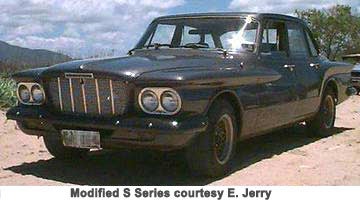
The first Valiant car to hit Australia was the Q; one was imported in 1960, but after it was sold it was wrapped around a tree. The Q could not easily be converted to right-hand drive, because the slant of the engine prohibited a simple gearbox move (see engineering). Otherwise, the Valiant seemed like a natural for Australia: it was a big hit in North America, and the right size for local tastes and fuel prices. The new slant six engine easily beat Ford and GM engines six-cylinder engines.
In January 1962, Chrysler created the R, a locally-assembled (from mainly American components) car based on the Plymouth Valiant; the idea was to bring a thousand Valiants to market as quickly as possible. The Valiant R’s engine, the 225 (3.7 liter) slant six, put out about twice the horsepower (145 vs 75) as the popular Holden, and had a push-button Torqueflite automatic or a three-on-the-floor manual transmission.
This family sedan had a quarter mile time of 19.5 seconds and a top speed of 145 km/h, and cost just 10% more than the much slower Holden. The car was an American Valiant converted to right-hand-drive, with styling that was to influence the 2005 Chrysler 300, but Chrysler chose to ignore the American base engine (the 101 hp 170 cid slant six) and using the optional “big six,” gaining around 45 gross horsepower. 1,009 R series Valiants were made, slightly more than the goal.
The Valiant S series took over one or two months later, and featured a larger gas tank, better braking, lower maintenance, and a three on the column manual transmission replacing the apparently balky console shift (the pushbutton automatic continued). 10,009 S Series Valiant cars were made, with local assembly from largely American components. Cosmetic differences included a finer mesh grille, neater tail lights beneath the fin, and a Valiant logo replacing the dummy spare.
Demand for the new car was high; for a little more money than comparable Holden or Falcon models, the car delivered more size, power, and performance. As a result of its success, Chrysler decided to expand local production to 50,000 units per year, with higher local content, at a cost of $36 million (which would later become $72 million).
Wheels tested the R&S series (with standard 3.7 liter slant six) and found it did 0-50 in 9.5 seconds, the quarter mile in 19.3 seconds.
If you are interested in the Q, R, and S Valiants, you may want to visit the American-oriented parts of this site. The R and S Valiant club caters for these early models.
Australian Production (AP5 and AP6)
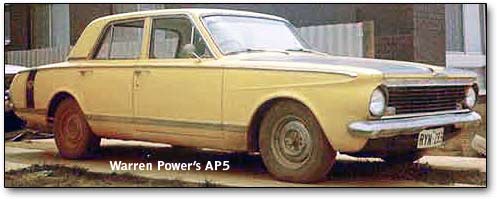 The AP5 (Australian Production 5) cars took over in 1963, with much more domestic content and engineering, and a new Regal version adding some luxury.
Australian engineers created a different body from the American Valiants, featuring a six-bar grille, squarer trunk, and cleaner lines. The interior had higher quality upholstery, in keeping with the car’s more upscale status.
As with past and future Valiant cars, the AP5 boasted a torsion-bar front suspension that prevented “nose dive” during braking, and combined cornering with ride quality. The rear suspension had a conventional leaf spring setup, engineered for traction under power. Wheels had double-sided safety rims; self-adjusting brakes had twin servos and a total 154 square inches of effective area.
The AP5 used the Holley 1920 carbuetor and an automatic choke (used in its American counterparts, alon with the BBD, through 1973); Chrysler used electrical components from non-Chrysler suppliers, notably Bosch and Prestolite, in keeping with the domestic content rules (Mike Sealey). The AP5 cars and later Australian Valiants were also sold in New Zealand and South Africa.
After the AP5 sedan, Chrysler released a wagon; they couldn't build enough Valiant AP5 cars to meet demand, with sales of 49,440 in 22 months.
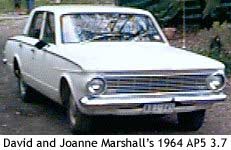 In March 1965, the AP6 was introduced. For the most part, it was a facelift, with a three section grille and new rear end, and improved paint (“Diamonite” acrylic lacquer). The TorqueFlite automatic was now column-shifted; and the carburetor went back to the Carter BBD used on the R and S, due to the AP5’s problems with surge and low mileage.
As the Valiant became heavier and the competitors’ cars improved, its speed advantage was evaporating. Then the American 273 V-8 was introduced in the AP6 Regal body. It had a premium price, a top speed of 107 mph, and a 17 second quarter mile time. Its performance dominated the market, even with the smooth, reliable three-speed TorqueFlite automatic.
Chrysler also brought out a 160 bhp version of the slant six as a $60 option on all Valiants. Later, they also made the V-8 an option ($210) at all price levels, requiring disc brakes, as did Ford with their own V8. Prices now ran from $2500 to $3650, and they made over 27,000 sedans and around 11,000 wagons.
They also started making utility versions (the “Ute”), eventually producing around 3,292 manuals and 1,131 automatics, by Gavin Farmer’s estimate in Great Ideas in Motion; there could have been a few hundred more built, as well, in the AP6 series. The Utility would continue until the CL series; its best was apparently the VJ series, with 14,856 built. This was the most popular Valiant series, overall, too.
Chrysler also took over Rootes Australia in 1965, including the plants in Melbourne.
The Valiant VC (AP7)
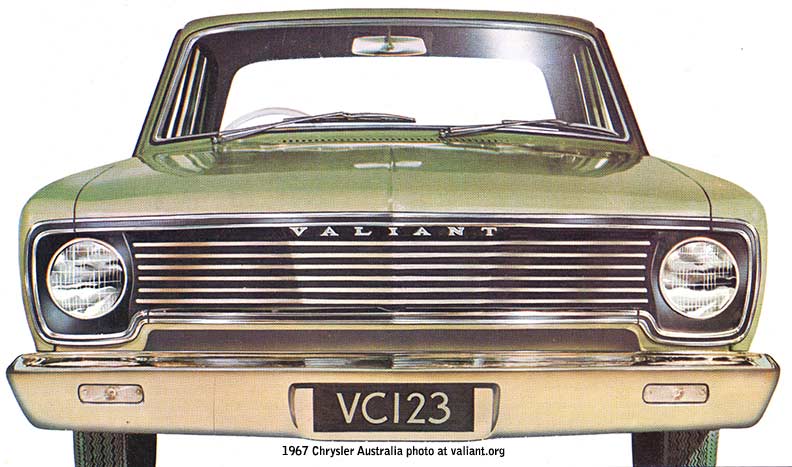
The AP6 was superseded by the VC series in 1966; within Chrysler, the VC was called AP7. The Valiant VC cars shared the same doors and structure as the AP6, but the Australian designers added a new nose and tail to give the impression of a much longer car.
The slant six still pumped out 145 hp at 4,000 rpm (215 lb-ft of torque at 2,400 rpm), with the 273 pushing out 180 hp (260 lb-ft); the three-speed manual transmission was now fully synchronized in every forward gear. The alternator, still a relatively new innovation, was standard.
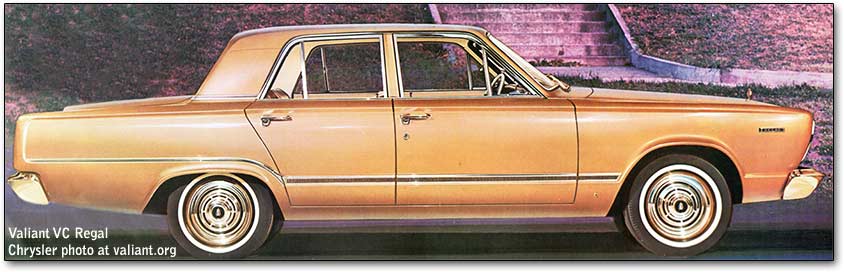
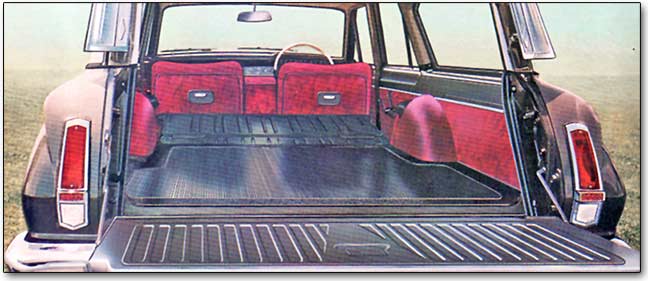
The VC brought two new cars: the first long wheelbase option for the Valiant, and the Safari wagon.
The Safari wagon boasted 105 inches of space from the tailgate to the back of the front seats (84 inches with the tailgate closed), with the same wheelbase and less than one inch of extra total length. The rear seats had a one-step fold-down operation; the rear window wound down into the tailgate, and if it was all the way up, the gate could not be opened from the inside (to prevent children from opening it). The roof had full length drip gutters, including one over the tailgate.
A 1966 Wheels article noted that Valiants had a high resale value and 12% of the new-car market. “From the beginning it set a new standard in performance...it has a very enviable record for faithful service.”
They considered Valiant to be “a biggish car,” and noted that the standard American 13 inch wheels were replaced by 14 inch wheels in Australia; they said that the average driver with an automatic would get around 21 mpg. “The Chrysler Torqueflite transmission is one of the smoothest and trouble-free units in the world, even when compared to Mercedes Benz and Rolls Royce.”
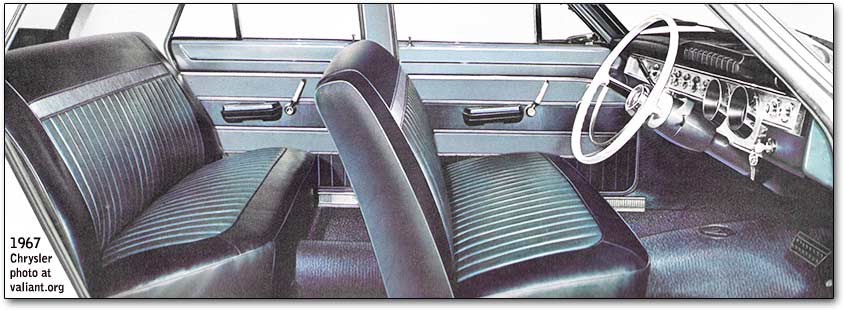
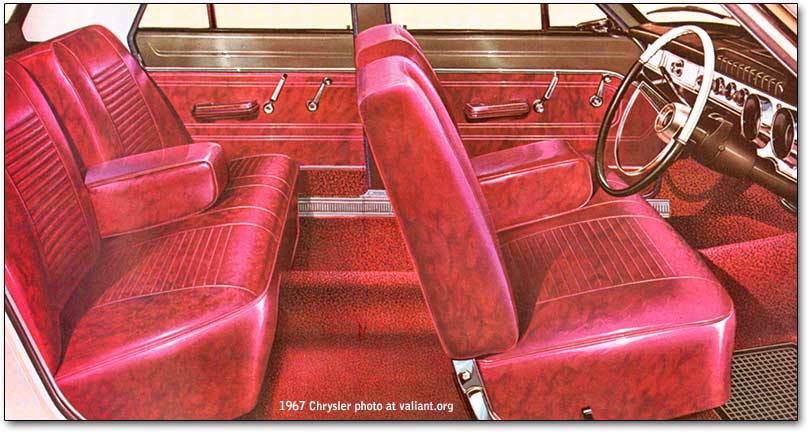
Regal (including the new Regal Safari) continued to be a high-trim version of the regular Valiant, with upgraded seats and more standard features — including standard floor carpeting, front and center armrests (just front for Safari), heater and defroster, day/night rearview mirror, dome-light switches on all doors, a trunk light, carpeted kick-pads on the doors, door-sill step plates, whitewalls, dual horn, and, on Safari, rear deflectors.
All Valiants came with electric windshield wipers, a windshield washer (foot operated), dual sun visors with a visor vanity mirror, armrests on all doors, coat hooks, cigar lighter, front-door operated dome light, turn signals and reverse lights, and seat belt anchorage points for the optional seat belts.
Wheels wrote that the greatest wear areas were brakes, tires, and suspensions; the standard shocks needed replacement by local units within as little as 6,000 miles, though the torsion bars were apparently more than rugged enough. Brakes were seen as adequate around town but insufficient for multiple high speed stops, with wear distance between 9,000 and 32,000 miles on the pads. The clutch was apparently heavy and not strongly attached given the switch to right hand drive. The short life of the points was also criticized; that would be resolved with elecronic ignition in the 1970s.
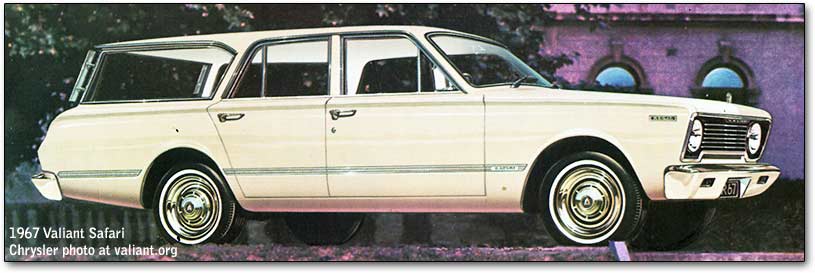
The VC was the most popular Valiant series to date, with nearly 43,000 sedans and over 14,000 wagons built, not to mention around 8,500 Utes.
In late 1966, GM launched the 1967 Torana Sunbird, which would result in the most memory Valiants ever sold. Chrysler Australia’s Ian Robilliard wrote:
The Valiant upgrade really began with our Product Planners, who bought competitive vehicles, and so had the last Torana before the Sunbird came on the scene. Then they replaced the Torana with a Sunbird, for reasons someone else may be able to identify. Sunbird was the model name of the four cylinder Torana, where GM dipped its toe into the water with Euro engineering when Hanneberger first showed what he could do.
I went out and drove the Sunbird, and came back to say to my Fearless Leader, the now-late Brian Ludlam, with what a total surprise this thing was, and if this could be done to the mobile disaster Torana, then God help us if they ever apply this development to the [then] HQ Holden: we and Falcon would be slaughtered in the market place. So for Chrysler Australia Limited, this story went “up the line,” thanks to Brian, and the story goes on from there.
I’d suspect Ford got the same rude awakening call. Can you imagine what would have happened if GM did not give away their game with the Sunbird?
In 1967, Chrysler opened a new engine plant in Lonsdale, and hit third place in national sales with over 13% market share — similar to its position in the United States. By this time, an average of 95% of each car was locally produced. Chrysler Australia was exporting to South Africa and other countries, becoming the second largest vehicle exporter in the nation.
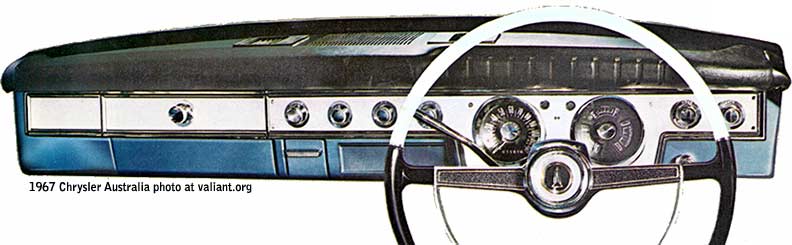
| (1967 specs in inches) | Sedans | Safari | All VC Valiants | ||
|---|---|---|---|---|---|
| Wheelbase | 106 | 106 | Turning circle | 37.1 feet | |
| Length | 188 | 189 | Rear axle ratio | 3.23:1 | |
| Width | 69 | 69 | Torqueflite gearing | 2.45, 1.45, 1.0:1; R, 2.2:1 | |
| Height | 55 | 55 | Manual trans. gearing | 2.95, 1.83, 1.0:1; R, 3.8:1 | |
| Trunk space (cu. ft.) | 26.5 | Wheels | 6.45-6.96” x 14”, steel |
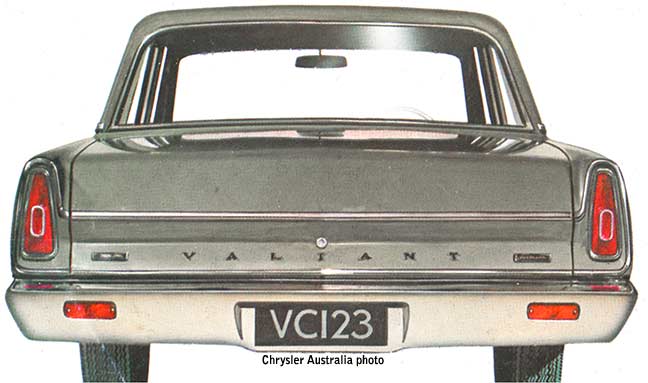
Valiant VE: Car of the Year
 The Valiant VE cars, which appeared in 1967 and were sold through 1968, were based on the new American 1967 A body but combined Plymouth Valiant midsections with a Dodge Dart-like front design, and a unique tail. The cars had a uniquely Australian roofline (the roof's trailing edge overhanging a complex-curved concave rear screen).
The VE was more squarish in shape than the past Valiants, and between the more conventional styling and two-inch longer wheelbase (to 108”), had greater interior space.
The 225 slant six continued with 145 bhp (109 kW), but a new 160 hp (120 kW) Super Six version with a two-barrel carburetor, revised camshaft, and upgraded exhaust was now available as well. The 273 V8 also gained some upgrades.
A larger gas tank (14 gallons, or 64 liters) was added, the transmission given a shorter gear lever throw, and the windshield wiper motor was moved to the engine side of the firewall to cut noise. Dual line brakes and front lap belts were made standard across the line for safety; front power discs were made standard with the V8.
The VIP began with the VE to fill the extended wheelbase luxury sedan market; the name derived from an upmarket full-size American Plymouth. The VIP’s wheelbase was initially unchanged (108") but was later extended to 112" and the styling made more distinctive (quad headlights, standard vinyl roof, frenched rear screen).
The VE was a critical and sales success; it was given Wheels’ Car of the Year award. They sold over 64,000 Valiants, including a bit over 5,000 Utilities.
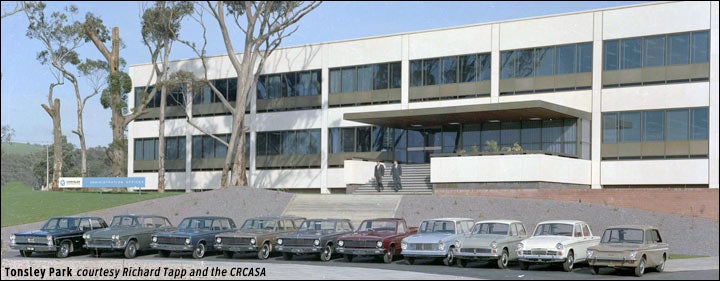
The VF brings the 318 and Pacer
The VF was introduced in March 1969. The VE middle section continued, but with new front and rear styling — a trick also used in the United States. The VE’s concave grille gave way to a horizontally convex design; turn signals were moved out of the bumper, allowing it to be thinner and giving room for bigger headlights.
Standard and Regal cars continued, while a new Regal 770 was slotted in just under the VIP model, which had upgrades to move upwards. The padded instrument panel was now joined by an energy absorbing steering column.
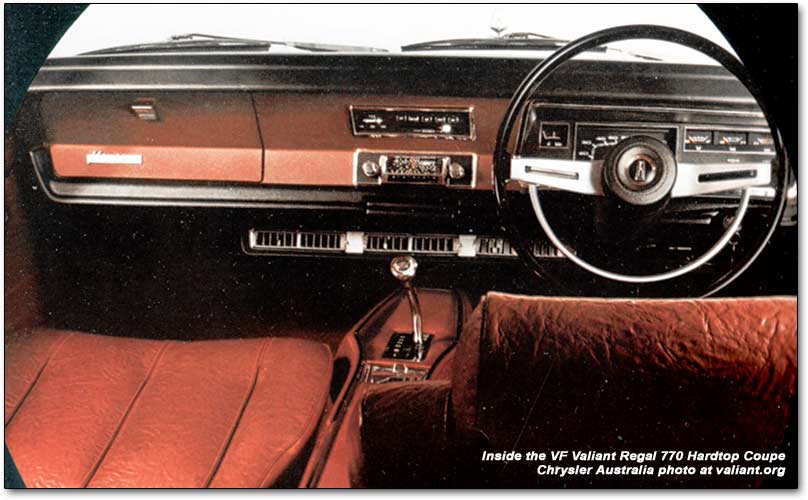
The 273 engine was replaced by its close relative, the LA 318 (an increased-displacement version of the same engine), increasing power to 150 net horsepower (230 gross hp); due to the weight gain of the VF, it ended up being only a little faster with the 318.
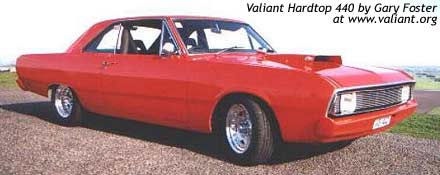
A new hardtop coupe used the Valiant front end on the US Dodge Dart body (it used the latter's longer 111" wheelbase and had the just detectable kinked body crease at the hipline). The VF hardtop was the longest two-door car ever made in Australia. It had the same front clip as the VF Valiants, and the standard engine was a retuned slant six that boasted 160 hp (rather than 145 hp) to move the car more effectively.
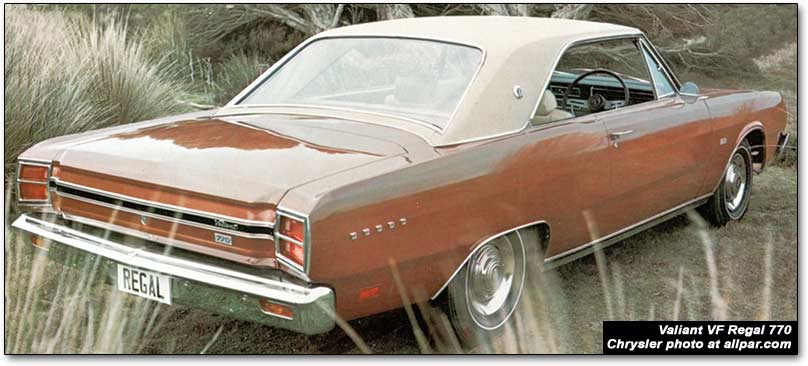
Valiant Pacer: presaging the Charger
In mid-1969, Chrysler brought out the sporty Valiant Pacer, powered by a high-performance slant six, beefed up suspension, floor-mounted four-speed, snarly exhaust, and built-in tachometer. The Valiant Pacer used a red and black grille with special body stripes, decals, colors, and faux-alloy wheels to establish itself as a sporty car. As with the American Road Runner, the interior had sports features but conserved on comfort items, with high-back bucket seats and black-on-white gauges and an “afterthought” tachometer.
The Pacer cost considerably less than competing cars, but had a high top speed, a 125-mm lowered suspension, standard front sway bar, and optional Sure-Grip differential; it had standard drum brakes, with optional front discs. The Pacer was lauded by the critics, with Modern Motor doing 0-60 mph in 10.4 seconds, with a 17.5 second quarter mile at 106 mph — while getting 23 Imperial mpg (around 18.4 US mpg).
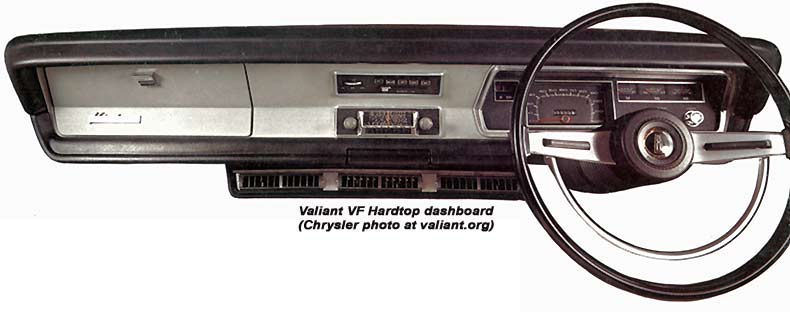
The new Pacer and VF Hardtop brought Valiant car sales to a new record, with 42,654 sold (around 2/3 of Chrysler’s sales) and a stunning $7 million net profit; the Pacer grabbed 11% of all Valiant sales. Chrysler market share in Australia actually topped its share in the U.S., at 13.7%. Overall, 52,944 VF Valiants were sold.
VG series and the Chrysler by Chrysler
New for 1970, the Valiant VG series had minor cosmetic changes but a major change: the first unique Chrysler Australia engine.
Work on the Hemi engine had started in 1966, with surprisingly good results. The engine, sold in 215, 245, and 265 cubic inch versions, took amazingly well to increased carburetion. The VG could now run the quarter mile in 16.4 seconds; the Pacer, with a four-barrel carb, could do it in under 16. Still, sales were slow, possibly due to the conservative body.
Around 200 VG hardtops came with the buttress-like sail panel extensions shown in the South American Charger article. These were known as "Mexicanas" in Australia, according to BT. Clare Richards' Mexicana is a 1970 VG, with the 318 V8 and an automatic transmission; the pillarless two-door car has the Regal 770 dash.
The long wheelbase models in the VH, VJ, and VK series were known as CH, CJ, and CK. These long wheelbase cars were known as the "Chrysler by Chrysler" and were loaded up with luxury items unusual in Australian made cars. They were available as four door sedans, or as a 2 door hardtop (with an enormous boot/trunk), and as they resembled elongated Valiants they still have a strange curiosity value today. They were introduced as a replacement for Chrysler Australia's previous "top-of-the-range" offering, the Dodge Phoenix, which was imported to Australia as a CKD (Complete Knock Down) kit, and assembled in Australia (using a variety of Australian Valiant parts, eg door handles, etc). The "Chrysler by Chrysler" range tended to be fitted out with power seats and windows imported from the USA.
 |
 |
Chrysler chose to introduce a Mitsubishi Galant with a Valiant badge in 1971; it sold well compared with the Simca and Rootes/Hillman cars.
Valiant VH: cars created by Chrysler Australia
The new VH was introduced in 1971, the product of joint engineering in the United States and Australia; all interior design was done in Australia. The VH would be exported to other countries, including South Africa.
 |
 |
Though only slightly longer than the VG, the VH was five inches wider and designed to look even larger; while it had a 111 inch wheelbase, it was almost as large as the American B-bodies. A mix of the Valiant and American B-body Plymouths (Belvidere / Road Runner), but with smaller dimensions, it was larger than the older Valiants, which were already considered to be large cars. With this change, the Valiant solidifed its reputation as a staid family car. Chrysler Australia managing director David Brown would quickly move to address that reputational shift.
| Hemi Six Packs | 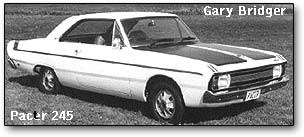 | ||||
|---|---|---|---|---|---|
| Code | Horsepower (gross) | Torque (lb-ft) | Quarter Mile | 0-60 mph | |
| E37/E48 | 248 @ 4,800 | 305 @ 3,400 | |||
| E38 | 280 @ 5,000 | 310 @ 3,700 | 14.8 seconds | 6.3 sec | |
| E49 | 302@5,600 | 320 @ 4,100 | 14.4 seconds | 6.1 sec | |
While past Valiants had been modified for Australian manufacture, the Australian Valiant was created by and for Australians, albeit from a basic design from Highland Park. Engineering the new lineup cost $22 million.
Mike Stacey told Hey Charger writer Gavin Farmer that it was “virtually an 111 inch wheelbase American B body,” while Burton Bouwkamp told us that it was an enlarged A-body incorporating B-body designs. Chrysler Australia produced all the tooling in-house.
 Styling was handled by Australians Brian Smyth (stylist), Bill Chinnick (modeller), Dean Bond (engineer), and Tom Campbell (tooling expert); Bob Hubbach, head designer of the American Charger, flew in to give the Charger his “tick of approval.” Sue Pedder wrote, “During the initial Charger design years, and then its birth 40 years ago, Bill Chinnick was a very young clay modeller in a large styling team headed by my father [Brian Smyth].”
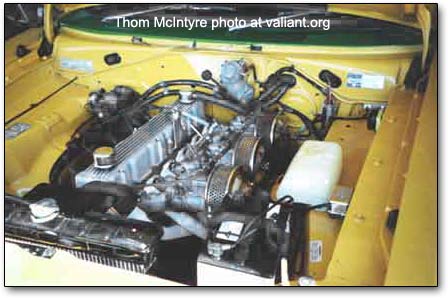
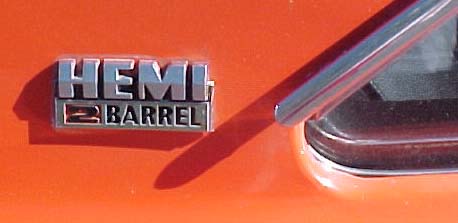
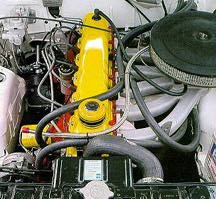
The 1971 Valiant VH had three engines: the 215, 245, and 265. The 265, a bored out 245, used the same pistons as the 318 to save money; the 215 was meant for economy. The trio were dubbed Hemis, though they lacked some attributes of a “true” Hemi.
There were numerous body types to choose from — long-wheelbase two and four door sedans (CH) and two-door hardtop, standard-wheelbase four door sedan, short and long wheelbase wagons and utilities. And, to add to the Pacer 265’s impact, a short-wheelbase two door performance version.
The VH Pacer had a higher performance 265, and it set a record for being the fastest mass-produced four-door sedan with a six cylinder engine produced in Australia (the record was indisputed until 1988). The key to its success, other than a well-designed and well-made engine, was the addition of triple Weber side-draft carburetors, tuned by Weber and Chrysler engineers in Italy.
Creation of the Valiant Charger
David Brown’s method for telling the Valiant’s performance story was a new car, the Charger. The Pacer had more than enough performance, but it was not making the desired impression. Brown, in a story detailed by Gavin Farmer in Hey Charger!, discussed the problem with chief engineer Walt McPherson; the idea of the Charger came from that. Managing Director David Brown reportedly took $2 million out of the overall $22 million Valiant reengineering budget to create the Charger in great secrecy, knowing that the Pacer would not be enough.
Brown asked Brian Smyth, head of styling, to come up with a short-wheelbase version of the VH; days later, he had a promising set of initial drawings. A prototype Valiant was soon delivered to the styling studios, and Smyth’s team did half the car in clay, using a mirror to create the impression of the full car. Bill Chinnick, the most junior of the styling team, was one of the clay modelers. (This story was verified by Sue Pedder, daughter of Brian Smyth, who noted that the whole clay modeling team helped Smyth to model to his drawings and design.)
By mid-December 1969, a group from Chrysler International was meeting with the Australian team to take the concept forward, building a low cost sports coupe; Hubbach and colleage Len Klemek were chosen to work on it in Australia.
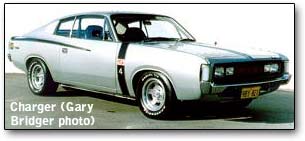 Possible names for the Charger included Racer (a play on Pacer), Challenger, and Rebel. These, like the idea of using the full VH hardtop roof, were abandoned. A new roof pressing led to the die-cast louvred panel behind the side windows: the panel hid the roof to quarter panel join, saving considerable labor and cost. (The idea was to make the panels functional, but this was not done.) A flat rear window was used, also saving money. The deck lid was adapted from the VH sedan: instead of pressing the full part, they just pressed the forward part. Numerous other ingenious workarounds and solutions were developed, saving precious engineering and tooling funds, and cutting the cost of the car.
The Charger was built on a shorter wheelbase, with a clean, sporty look; it was 130 kg lighter than any Valiant sedan, but it still had room for five. A hatchback was engineered and a prototype made, but it was never produced.
A $2800 base model led to high production runs, lowering the cost of the sportier models. The stock Charger XL came with a 245 six-pack; the base Charger came with a 215. The R/T came with a 265 Hemi. Finally, the Charger 770 added some luxury touches, and had either the stock 265 or a smoother 318 V-8. Torsion bar suspensions provided good handling.
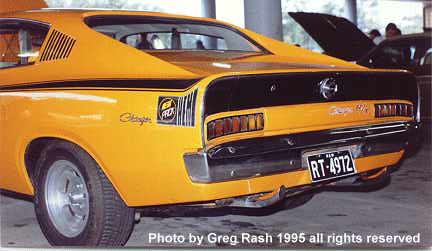 The 1971 Charger was based on the Valiant VH, but was a short-wheelbase 2-door version. It could be equipped with a small V-8 or the "ordinary" 265 Hemi. The "ordinary" version had 203 hp and 262 lb-ft of torque at 2,000 rpm, making it competitive with V-8s. The high-performance version was reserved for the Pacer - for now.
The Charger R/T had a 3.23 differential rather than the 2.92 standard in other Chargers; six-inch rims; a front anti-roll bar; a tach; and an oil pressure gauge. Stock, it could run a 15.7 second quarter mile. Optional was the "six-pack" package, using three two-barrel Webers to put the 265 up to 248 hp (30 hp more than the standard R/T 265).
The final option was the E38 engine, with a higher compression ratio, different gear ratios, and 280 hp (gross) - about 80 hp more than the standard 265! This brought the quarter mile down to 14.8 seconds, with a single gear change. Zero to sixty (mph; about 100 km/h) was 6.3 seconds. Performance was about the same as Ford's 351 V-8 Falcon GTHO. Handling was "exceptional," possibly due to the light engine. Racer Leo Geoghegan noted that the Charger E49 R/T handled well on the track, straight off the assembly line, while most cars needed a great deal of tuning. Just 1,300 were made.
The 1972 E49 Charger was another significant move forward, and not just because it was the first to get a four-speed manual gearbox (from Borg-Warner). The E49 pushed the 265 engine to a full 302 hp, and had the quickest acceleration of any Australian production car - 14.4 seconds in the quarter mile, six seconds and change 0-60, respectable even when compared to American big-blocks or 1990s sport compacts.
Sports Car World tested the E49 and achived 0-60 mph in 6.1 seconds, and 0-100 in 14.1 seconds. They wrote, “It’s so fuss-free that your mother could puddle back and forwards ot the supermarket. Such is the incredible E49, a road-going racer and a damned good one at that. It’s exciting to the extreme...” [Thanks to Hey Charger! for these figures and excerpts.]

The 340 V-8 was Chrysler's last high-performance V-8 intended for cars. In the American Dusters, it was a match for many big-blocks, but was often underestimated in the US. It became a VH Charger option in late 1972; but it was used, like previous V-8s, mainly as a status feature. It was only available in the Charger 770 E55, a full-luxury version of the Charger. With an automatic, its performance was better than the manual XA GT Falcon. Zero to sixty (mph) was 7.2 seconds, and the quarter mile was an impressive 15.5; top speed was over 200 km/h. The camshaft was nonperformance (the same as that of the 318) and the exhaust was restrictive; it was capable of more, but that role was given to the 265 Hemi.
VJ and VK, CL and CM
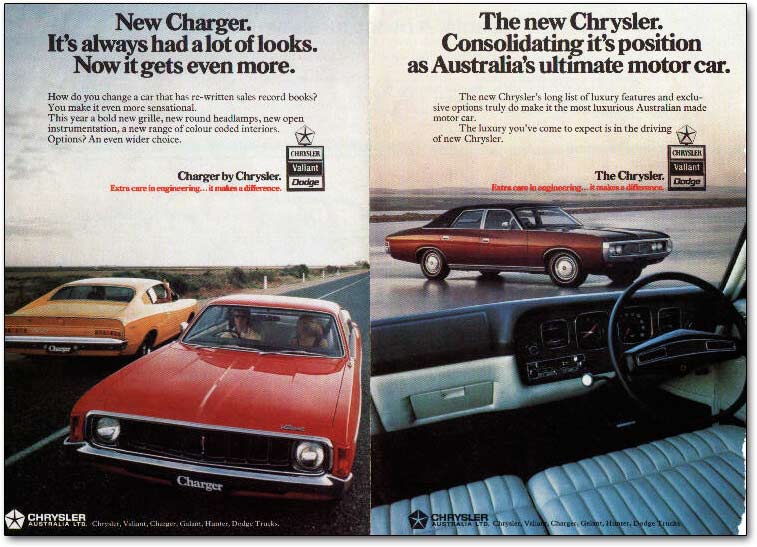
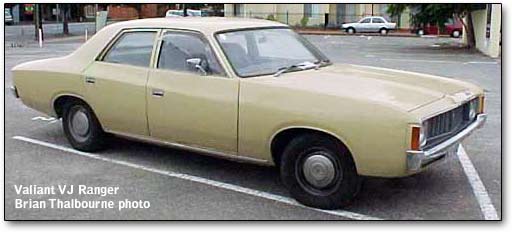 The VJ and VK Chargers continued with the Hemi Sixes, as well as the V8 318 or the 360, a bored-out version of the 318. The 360 ran the quarter mile in 16.2 seconds, the 318 in 16.7 seconds; 0-100 mph in was 25 seconds with the 360, 26 seconds with the 318).
The Valiant VJ spawned a new model, the Ranger.
In 1976 the CL Series of Valiants was launched; the long wheelbase Chrysler by Chrysler was dropped.
The CL series introduced the first Valiant "Panel Van" model, which it was claimed was the result of intense market research by Chrysler Australia (GM Holden and Ford had been offering panel van derivatives since the 1960s). No-one was suprised when this panel van turned out looking like a Utility with a roof. (See the Centura for another example of odd new cars.)
In the CL series, sports versions of the Panel Van and Utility were offered during the panel van craze of the late 1970s (to compete with Holdens "Sandman" and Ford's "Sundowner") and these were known as the "Drifter" (a critic apparently claimed the name described the torsion bar/leaf spring handling).
Drifters were fitted with a Charger honeycomb grille, wide side stripes, blackout treatment around the side windows, and styled steel wheels, the panel vans have a huge black triangular plastic fitting behind the front door window that resembles an air vent but may not have any function. Drifters also were probably fitted with upgraded suspension, and any number of other options. Drifter Panel Vans are fairly common, but apparently less than ten Drifter Utilities were actually produced, and are now quite rare.
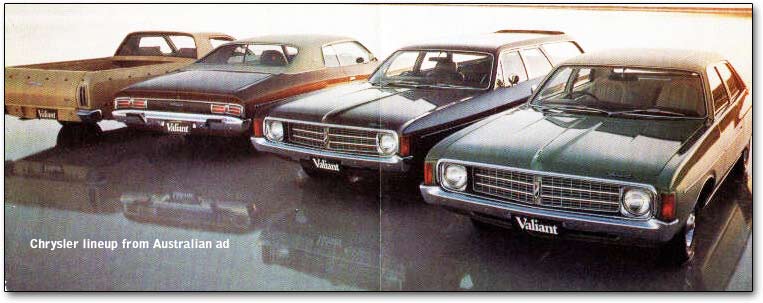
Television Valiant Van (by Chris Keating)
A one-off Valiant panel van was custom-built by Chrysler in 1971, for use by Crawfords Productions. Crawfords were producing three weekly police drama series, one of which ("Division 4") was set at a suburban police station. Suburban police stations in Victoria used modified panel vans, termed "divisional vans," as patrol vehicles. The body modifications consisted of the rear tailgates being removed and replaced by a single door, and bars fitted to the windows of the van section.
Crawfords had just switched their vehicle allegience from Holden to Chrysler, meaning that Valiants would be used in all their programs from that point on; so Chrysler custom-built them a one-off VH "divvy van" for use in "Division 4"!
Registered LDH-018, it was also used in episodes of "Homicide," "Matlock Police," and "Bluey," by which time (1976) the front sheet-metal had been upgraded to VJ. The van was also used extensively in the first year or so of "Cop Shop" (1977), and was last seen in the background in an episode of "Special Squad" (1994).
Making this even more interesting, Dodge was making small commercial vans in England at the time!
 The CL series Charger disappeared in 1978, and the last sports model Valiant was the CM series Valiant GLX. By this time, Mitsubishi Australia was half owners of the Valiant factory, and Valiant under-bonnet compliance plates were starting to have “Mitsubishi” printed on them, and referring to the “Chrysler” name as being used “under license from Chrysler America.” The writing was clearly on the wall.
The GLX had a substantially upgraded “Radial Tuned Suspension.” A Valiant was shipped to America to have the suspension tuned further, and it was returned with Chrysler stating that the Valiant had better handling than any large car they had produced.
Iain Robilliard wrote, “I was the suspension project engineer at that time, and I was preparing to go to the US to have them help us sort out the ride and handling. We sent the car over, and their letter led to my trip being cancelled, and given the job of coming up with the Australian designed-and-developed answer to GM's Radial Tuned Suspension package following the release of the RTS package on the Sunbird [later Torana]. My picture appeared in all the local motoring magazines... Much later, I was assigned to Chrysler Corp. to attend the Chrysler Institute, along with a couple of other engineers, and met the guys who recalled their time with our Valiant, and confirmed their amazement at what we had achieved before the Radial Tuned suspension.”
The GLX was also fitted with a 4 speed floor shift Borg Warner gearbox, and the Electronic Lean Burn (ELB) 4.3 Litre Hemi 6 cylinder; this combination was in the right hands able to achieve fuel economy of over 30 miles per gallon (Imp.). Nevertheless, customers after sports handling had left the Valiant for the newer generation Australian cars, such as the Holden Commodore and XD Falcon. The GLX can be identified by a black stripe down the side (similar to the "Drifter"-style stripe) that ends at a "GLX" badge on the rear C-pillar.
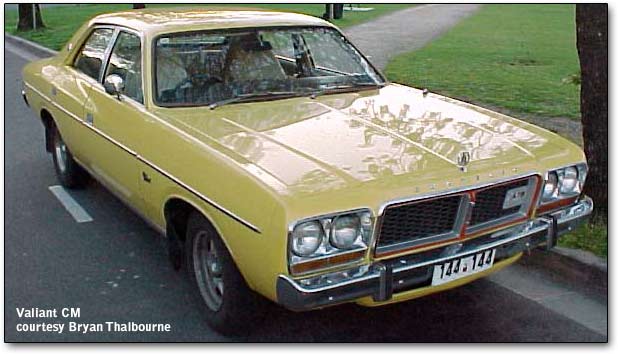
Later cars were designed to look bigger than they were, with dual headlights and imposing grilles (reminscient of B-body Dodges and Plymouths of the time); but buyers in Australia and the United States alike now wanted large interiors with small exteriors. There were quality problems each time a model was introduced, and racing support was minimal. The Charger had died in 1978 as part of the “muscle car scare,” and with it went much of the Valiant's sales along with all of Chrysler's home-grown production performance.
The Sigma, a Mitsubishi with a Chrysler badge, sold well but did not help the local plant. There was some talk in the late 1970s of bringing K-cars (Reliant/Aries) into Australia, but it never happened. The last Valiant, the CN, also never saw production.
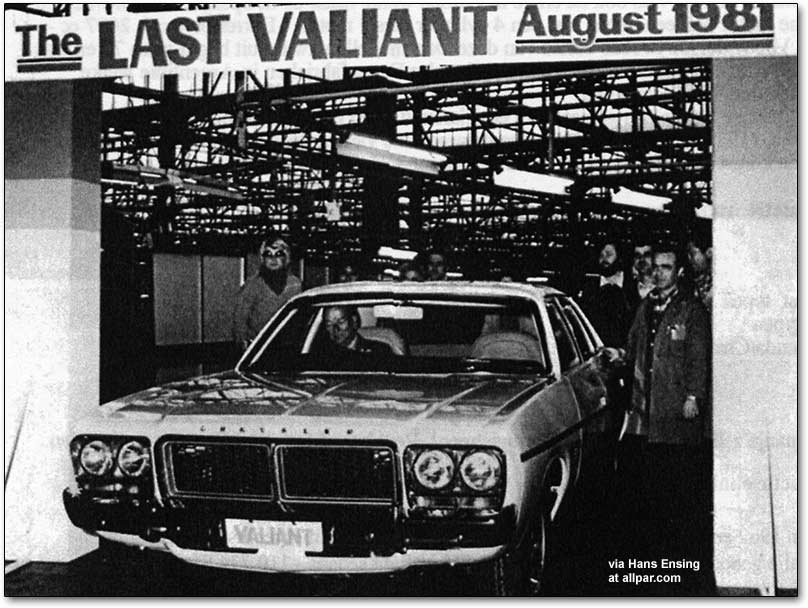
Mitsubishi took over Chrysler Australia in 1980, buying 99% of the equity in the company. The name Chrysler was dropped in October 1980; the last Valiant was produced in August 1981, bringing the total to 565,338.
Postludes
Mitsubishi Australia has no records of the Valiant, aside from some sales literature.
When Valiant production ceased, ex-Chrysler Australia engineers concentrated on designing the Mitsubishi Magna. Rather than working out ways of reducing the size American cars to fit Australian tastes, in the case of the Magna, they widened a front wheel drive Sigma, to give it the interior room that Australians wanted, and created a success story that was adopted by Mitsubishi head office in Japan. The new car was exported around the world as the Diamante.
Essential Links
| Valiant and Chrysler | Valiant Charger |
|
|
The primary source for this page was Gary Bridger’s Hey Charger!, sent by Robert Pascale. Much information was added later or corrected by Darren Ponton, Bryan Thalbourne, Tom Miller, and many others.
The speed record
Some have said the E49 Charger's record as the fastest Australian production car across the 1/4 mile was beaten in the 1990s by the Holden GTS-R (Commodore, 5.7 Litre), which was clocked at 14.3 seconds (the figures for the E49 usually quoted are 14.4 seconds; a dubious-accuracy 14.1 figure can be beaten by the “Blueprint” GTS-R which can do 14 flat).
Gary Bridger, author of Hey Charger!, set us straight:
The June 1997 issue of Australia's Motor magazine did a comparison between Australia's greatest muscle cars from 1971 on, including the GTS-R and E49. Despite being the only six-cylinder in the group, the 25 year old Valiant Charger E49 was still the fastest, and marginally quicker than the GTS-R to 100 kph and through the quarter.
The figures used for the E49 were based on 1972 road tests, 0-100 kph 6.1 seconds and 14.4 seconds for the quarter. The GTS-R was quoted as 0-100 kph 6.2 seconds and 14.45 for the quarter.
To add salt into GM and Ford's wounds, stock standard E49s on modern rubber have quite easily broken the 14 second barrier for the quarter. Jim Little has done a 13.8 quarter in his and another of our club cars won a production prize at a major drag meeting with a 13.9 quarter. A previous owner took my E49 to a sprint meeting and was doing 14.1 quarters on old wide oval tires, limiting the car to 5000 rpm (redline 6500) and in a howling headwind! A Ferrari owner who couldn't match those times was absolutely horrified when he discovered that the Charger had a Valiant 6 under the bonnet! An unmodified standard production Valiant 6 at that.
Hey Charger! the book (Alternate Source) | Reviews of Australian Valiants | Hear Graham Pratt's 265 Hemi
 Your Privacy Choices